
"Extraordinary claims require extraordinary evidence," or the art of saying nothing with authority
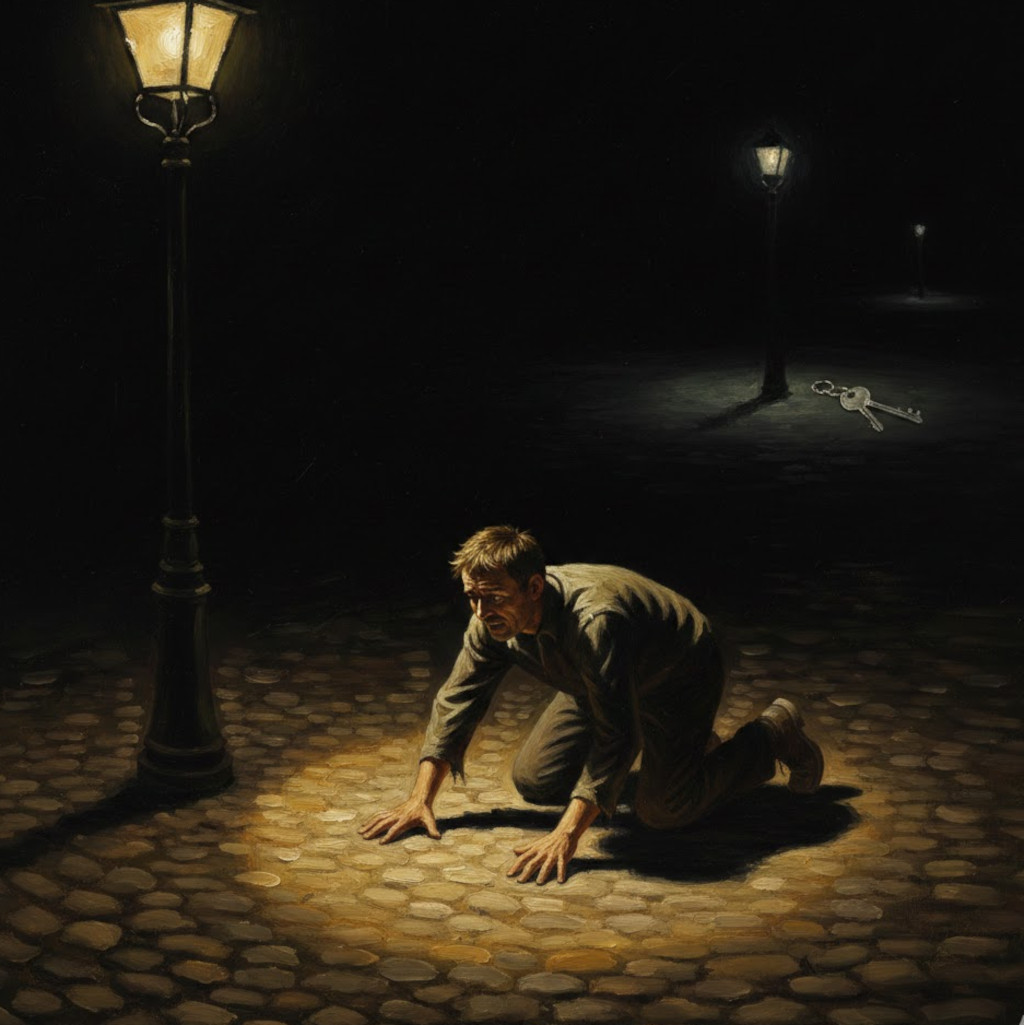 A man searching for his keys under a streetlight, in a circle of light. Far away in the darkness, the keys gleam. The entire epistemology of the slogan in one image.
There are phrases that function like passwords. You utter them, and doors open: the door of intellectual respectability, the door of the club of people who "think for themselves" (that is, who all think the same thing), the door of the camp of self-proclaimed rationalists. "Extraordinary claims require extraordinary evidence" is one of those phrases. It is to New Atheism what "it is forbidden to forbid" was to May '68: a slogan that sounds good, that spares you from thinking, and that collapses the moment you look at it closely.
I already touched on the question in an old post1, from the angle of the notion of proof. Today, I'd like to go further and show that this slogan, far from being a rational principle, is a masterpiece of philosophical vacuity. It says nothing. It proves nothing. It refutes nothing. It impresses, which is not at all the same thing.
Where does this phrase come from?
Let's start with the origins, because the history is delicious.
It is generally attributed to Carl Sagan, in his Cosmos (1980). Sagan had himself borrowed it from Marcello Truzzi, sociologist and founder of the Zetetic Scholar, who formulated it thus: "An extraordinary claim requires extraordinary proof." Truzzi, in turn, was inspired by Pierre-Simon de Laplace: "The weight of evidence for an extraordinary claim must be proportioned to its strangeness."
And if we go further back, we land on David Hume: "A wise man proportions his belief to the evidence."
Let us note two things. First, the formula shrank at each stage. Hume spoke of proportioning belief to evidence, which is a principle of common sense. Laplace spoke of proportioning the weight of proof to strangeness, which is more precise. Truzzi and Sagan simplified to "extraordinary/extraordinary," which is punchier and infinitely vaguer. It is the fate of every idea that passes from philosophy to slogan: it loses in rigor what it gains in applause.
Second, and this is ironic, Truzzi himself ended up regretting the formula. He spent the end of his career criticizing dogmatic skepticism, the kind that uses ECREE (the consecrated acronym) not as a tool of prudence, but as a shield against any disturbing idea. The father of the slogan disowned his children. But the children didn't listen, because the slogan is too useful to be allowed to die.
The word that does all the work
The entire trick hangs on one word: extraordinary.
What is an extraordinary claim? The slogan doesn't say. It can't say, because the answer depends entirely on the frame of reference of the person judging. And this is where the slogan ceases to be a principle and becomes a sleight of hand.
For a convinced materialist, the claim "God exists" is extraordinary. Obviously. It contradicts his metaphysical framework. It therefore requires, according to the slogan, "extraordinary proof," which in practice means: massive empirical evidence, reproducible, ideally double-blind, with a control group and a publication in Nature. Since such proof is by definition impossible for a being that is not an empirical phenomenon, the materialist triumphantly concludes that there is "no evidence." QED. Move along.
But let's turn the thing around. For a Thomist, the claim "there exists nothing beyond matter" is extraordinary. It contradicts the universal experience of finality, the existence of reason, the intelligibility of the real, and twenty-five hundred years of metaphysics. What "extraordinary proof" does the materialist bring for this extraordinary claim? None. He cannot, because materialism is not an empirical conclusion: it is a metaphysical presupposition, exactly like theism, except that it has the additional peculiarity of negating itself (eliminative materialism being, as I have shown elsewhere, a position that refutes itself the moment it is stated).
Do you see the problem? The slogan settles nothing. It merely reformulates the position of the person invoking it. It's a mirror disguised as an argument. To say "your claim is extraordinary, therefore I need extraordinary proof" is to say "I disagree with you, therefore you'll have to convince me very hard." Which is perfectly legitimate as a personal attitude, but which has strictly zero value as an epistemological principle.
The ghost of Hume
ECREE is, at bottom, a popular reformulation of Hume's argument against miracles. And that argument suffers from exactly the same vice: it is circular.
Hume maintains that the uniform experience of humanity testifies against miracles, and that consequently no testimony is sufficient to establish one. But this is precisely what is in question. Is experience "uniform"? The Christian says no: there have been miracles, attested by witnesses. Hume replies: those testimonies don't count, because experience is uniform. The Christian asks: how do you know it's uniform? Hume replies: because testimonies of miracles don't count.
It's a perfect circle. One excludes the data that contradicts the thesis, then invokes the absence of contradictory data as proof of the thesis. It is methodologically indistinguishable from looking for your keys only under the streetlight because that's where the light is, then concluding that the keys don't exist because you haven't found them.
ECREE does exactly the same thing, but more subtly. By qualifying a claim as "extraordinary," one raises a priori the threshold of required proof to a level the claim cannot, by its nature, reach. Then one concludes it is unproven. This is not epistemology. It's conjuring.
The lesson of history
If ECREE were a valid principle, the history of science would be very different. Consider some claims that, in their time, were spectacularly "extraordinary":
"The Earth revolves around the Sun." In the sixteenth century, this claim contradicted direct experience (you don't feel the Earth moving), scientific consensus (Ptolemaic geocentrism), common sense, and the dominant interpretation of Scripture. It was, in the strictest sense, an extraordinary claim. And what was Copernicus's proof? A more elegant mathematical model. No "extraordinary" proof. No direct empirical demonstration (that wouldn't come until Foucault, three centuries later). Just an argument from simplicity and theoretical elegance. By ECREE, heliocentrism should have been rejected until 1851.
"The continents drift." When Wegener proposed continental drift in 1912, the geological consensus was unanimously against him. The claim was extraordinary. The proof? Coastline shapes that fit together and similar fossils on separated continents. That's not "extraordinary." It's ordinary observation, interpreted in a new framework. Wegener was mocked for half a century. ECREE would have sided with the mockers.
"Invisible organisms cause diseases." The claim of Semmelweis, then Pasteur, was extraordinary in light of the medical consensus of the time (miasma theory). The proof? Hospital statistics and laboratory experiments. Perfectly ordinary proof. But "extraordinary claims require extraordinary evidence," right? Semmelweis died in an asylum.
The pattern is always the same. A claim is "extraordinary" only relative to the consensus of the moment. The consensus of the moment is not a criterion of truth. And the evidence that overturns a consensus is almost never "extraordinary": it is ordinary evidence that nobody wanted to look at.
What the slogan really hides
Let's be frank. ECREE, in 95% of its uses, does not mean "proportion your belief to the evidence." It means one of these three things:
1. "I am a materialist, and I don't feel like justifying it." Materialism is treated as the default position, the "degree zero" of metaphysics, such that any claim contradicting it is automatically "extraordinary" and must bear an asymmetric burden of proof. But materialism is not a default position. It is a metaphysical thesis, with presuppositions, implications, and problems (the problem of consciousness, the problem of intentionality, the problem of abstraction, the problem of reason itself). Treating materialism as the neutral starting point is doing metaphysics while pretending not to, which is the most insidious form of dogmatism.
2. "I don't know the arguments, and the slogan spares me from learning them." This is the most common use. Someone mentions the cosmological argument, the teleological argument, the argument from contingency. Instead of examining them, one draws ECREE like a shield and moves on. The slogan functions as a talisman against thought: it gives the illusion of having responded without having examined anything.
3. "I confuse the type of proof with the strength of proof." This is the heart of the problem. ECREE implicitly presupposes that the only proof that counts is empirical proof, and that the further a claim strays from the empirical domain, the more massive the required empirical proof must be. But this is a category confusion. The existence of God is not an empirical hypothesis. It is a metaphysical conclusion. The arguments in its favor are metaphysical arguments: the argument from contingency, the argument from causality, the argument from finality. Demanding empirical proof for a metaphysical conclusion is demanding that a fish climb a tree, then concluding that fish are incompetent.
The real principle
There is a real epistemological principle behind ECREE, and it is banal enough to make you weep: belief should be proportioned to evidence. That's what Hume said, and it's a truism. Nobody disputes it. The problem is that "proportioned" does not mean "of the same type" or "of the same size." The proof must be suited to the object. And the object determines the type of relevant proof.
You don't prove a mathematical theorem by experiment. You don't prove a physical law by pure deduction. You don't prove the existence of a metaphysical being by microscope. Each domain has its criteria, and wisdom consists in applying the right criteria to the right object, not in erecting the criteria of one domain as a universal norm.
Thomas Aquinas knew this. Aristotle knew it before him: "It is the mark of an educated man to look for precision in each class of things just so far as the nature of the subject admits"2. It is as unreasonable to demand empirical proof of God's existence as it is unreasonable to demand a mathematical demonstration of the existence of your cat.
The final self-refutation
And to finish, the question nobody ever asks, and which should be the first:
Is ECREE itself an extraordinary claim?
Think about it. "Extraordinary claims require extraordinary evidence" is not an empirical observation. It is not a scientific fact. It is not an experimental result. It is an epistemological thesis, a philosophical claim about the nature of proof and belief. And like every philosophical thesis, it must be argued for.
What is the "extraordinary evidence" for ECREE? There is none. There never has been. The slogan sustains itself by its own authority, that is to say, by nothing at all. It is a self-proclaimed principle, never demonstrated, often invoked, and whose persuasive force rests entirely on the fact that it sounds rational, which is the very definition of a sophism.
And if you apply ECREE to itself, it collapses. "The claim that extraordinary claims require extraordinary evidence is itself an extraordinary claim (non-empirical, non-obvious, philosophically contestable), and it has no extraordinary evidence to support it." By its own criteria, ECREE is unworthy of belief.
This is the infallible mark of a bad principle: it doesn't survive its own application. Like "there is no truth" (which claims to be true), like "reason can't prove anything" (which is a rational argument), ECREE devours itself the moment you turn it around. It's argumentative aikido in its purest form3, and it's a pleasure to practice.
The final word
The next time someone hits you with "extraordinary claims require extraordinary evidence" with the quiet assurance of someone who believes they've closed the debate, ask them three questions:
- What do you mean by "extraordinary"? (They won't know.)
- Relative to what frame of reference? (They won't have thought about it.)
- Does this principle apply to itself? (They'll change the subject.)
And if they don't change the subject, congratulations: you've found an honest interlocutor. Buy them a coffee and start talking metaphysics. That's how good conversations begin.
See my post "Why saying one believes 'without proof' is an absurdity, or there is always proof."
Aristotle, Nicomachean Ethics, I, 3, 1094b24. The full passage is a lesson in methodological humility that every scientismist should have tattooed on their forearm.
See my post "An effective antidote against specious arguments, or the art of argumentative aikido."