
The burning void of death, or why the anguished must not be stopped from their anguish, or why anguish is proof that God is
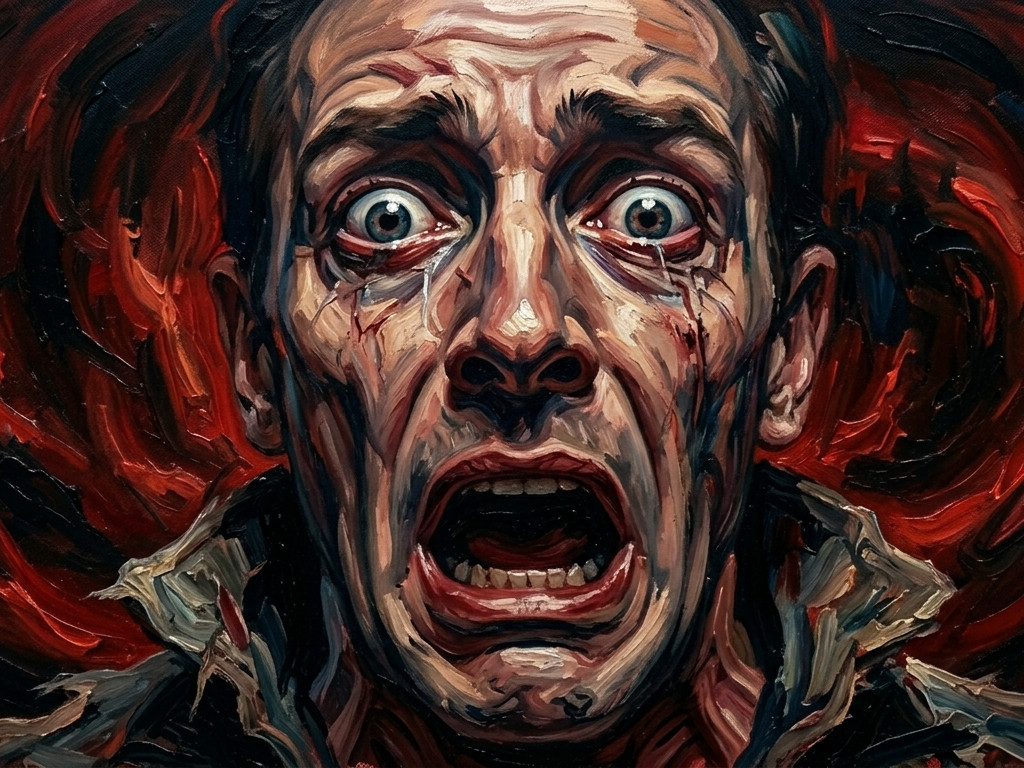 A man screams his anguish into the night: "My God, my God, why have you forsaken me?" (Matthew 27:46)... or God is dead? Is it not the same thing, for the sensible man?
"Show me your glory." Moses, Exodus 33:18.
"You cannot see my face, for no one may see me and live." YHWH, Exodus 33:20.
"The Nothing does not exist, no doubt — that is even the definition that speaks of it best, at the closest to itself. But it is nonetheless felt. Dimly, but really felt." Angelus Silesius.
"Please help me, I'm panicking, and I have nothing to say to the atheists." You, right now.
Lent is drawing to a close. I had wanted to wait a little longer before publishing this text, to let it mature, to rework it. But over these past few days I have seen several messages from horribly anguished people scroll by on social media. People searching for answers, finding none, drowning. I could not wait.
I wrote this text because I know what it speaks of.
Not from the outside. From the inside.
I have been there. Those nights when anguish arrives without warning, when it settles into the chest like a beast, when the arguments you thought were solid collapse one after another and the ground gives way. I may give the impression of an upright man, confident in his reasoning, at ease in controversy. That is not false. But it is not the whole truth. I fall back into it sometimes. The anguish returns, discreet or brutal, and I recognise its face.
What I have learned is that you must not chase it, nor flee it. You must go through it. And when you go through it truly, all the way to the bottom, you find something you were not looking for.
This is the experience I am trying to put into words here. Not to be done with anguish, for it is part of what we are, and it has its good side, sometimes. But to give back to someone else what I had the grace to experience: that the abyss is not empty. That what is frightening is not nothingness. That anguish itself is a form of contact with something greater than us.
If you are reading this at 2 in the morning, breathless, I have recognised you. Keep going.
I. Preamble: you are knocking on the wrong door
You came here to be reassured.
I can picture the scene. It is late, perhaps 2 in the morning, perhaps 4. You cannot sleep. The anguish is there, that familiar beast, coiled in your chest, tightening. You read something, an article, a comment, a video, and the arguments seemed unanswerable. Determinism. Materialism. Brute facts. Nothingness after death. The absence of meaning. You searched for refutations, found a few, but they did not convince you. Not really. Not enough.
So you came here.
You want someone to tell you that determinism is false. That nihilism is absurd. That materialism refutes itself. That God exists and everything will be fine. You want solid arguments, ironclad proof, certainties that would finally shut up that thing in your chest.
I am not going to do that.
No. That is not how it works.
You want a refutation of your fears? I am going to give you their confirmation.
You want light? I am going to give you darkness.
You want to be reassured? I am going to terrify you.
Because it is the only path. Because you have not pushed the anguish far enough. Because you stopped along the way, and mistook a small void for the real one. And the real one, the true one, is waiting for you on the other side.
Hold on. We are going down.
II. I concede everything
You want me to refute determinism?
No. I concede it.
Everything is determined. Absolutely everything. Every thought you are having right now, every tremor of anguish, every heartbeat, every word you read: all of it is the necessary product of a blind causal chain reaching back to the Big Bang. You have never chosen anything. You will never choose anything. Your "decisions" are retrospective illusions, stories your brain tells itself to give some semblance of coherence to the mechanical flow of neural events. You are not a subject. You are an object, a particularly complex object admittedly, but an object all the same. A temporary configuration of matter, traversed by forces it does not control.
Granted.
You want me to refute materialism?
No. I concede it.
There is only matter. Atoms. Quarks. Force fields. Energy transforming itself according to blind laws. What you call "consciousness" is only an epiphenomenon, background noise, foam on the wave, an artefact of information processing by a sufficiently complex neural network. There is no soul. No "you" behind the neurons. Just neurons. And when the neurons stop, when the heart ceases to pump, when oxygen no longer reaches the brain, you will switch off like a light bulb. No tunnel of light. No last judgement. No reunion with loved ones. The dark. The nothing. Not even the dark, actually, because there will no longer be anyone to notice that it is dark.
Granted.
You want me to refute brute facts?
No. I concede it.
The universe exists. Why? For nothing. It is simply there. It is a brute fact, a fact without reason, without explanation, without foundation. There is no ultimate "why". The question itself is poorly formed. You can ask "why?" to infinity, like a tiresome child: at some point, the chain stops, and the only honest answer is: "That's just how it is." The universe owes you no explanation. It owes you nothing. You are merely an accident in a process going nowhere, produced by a cosmos that has no intention.
Granted.
You want me to refute nihilism?
No. I concede it.
There is no meaning. No purpose. No direction. The universe was not created for anything. Life has no finality. Your life has no finality. What you take for "meaning", your work, your relationships, your projects, are only distractions you build for yourself to avoid looking at the abyss. But the abyss is there. It has always been there. And when you die, all that "meaning" will disappear with you, as if it had never existed. Which, in a sense, will be true, because it never existed except as a useful illusion, a secretion of your brain to keep you alive long enough to reproduce.
Granted.
You want me to refute agnosticism?
No. I concede it.
We do not know. We cannot know. Any claim to absolute knowledge is a fraud. The arguments for God? Insufficient. The arguments against God? Insufficient too. We float in an epistemic fog we will never escape. You can accumulate evidence, probabilities, "maybes", but certainty will be denied you. Forever. You will live and die without knowing. And that is perhaps the worst of it: not the certainty of nothingness, but eternal uncertainty, the doubt that never resolves, the question that stays open like a wound.
Granted.
III. Your condition
Now, look at your situation.
You are here. A small contingent being. An assemblage of carbon and water that has aggregated for a few decades on the surface of a ball of rock, itself lost in a spiral arm of a galaxy among two trillion galaxies.
You did not choose to exist. You did not choose your parents, your country, your era, your body, your brain, your predispositions. You did not choose your first thoughts, which conditioned the next, which conditioned the next. You arrived, as one arrives on a theatre stage knowing neither the play nor the role.
And you are going to leave. In ten years, in fifty years, in seventy years if you are lucky. Your heart will stop. Your neurons will fall silent. And what you call "you", this thing reading these lines right now, this consciousness that worries, that hopes, that suffers anguish, this thing will no longer exist. As it did not exist a hundred and fifty years ago. As it will no longer exist in a hundred and fifty years.
A parenthesis. A brief fluctuation in the flow of matter. A tremor of complexity between two eternities of silence.
That is your condition.
And faced with this, what can you do? Nothing. You can distract yourself: that is what most people do. You can build "projects", "meanings", "reasons to live". But you know, deep down, that these are sandcastles. The tide is rising. It will erase everything.
You can also suffer anguish. That is what you are doing right now. You look at the abyss, and the abyss looks at you. And you are afraid.
You are right to be afraid.
IV. The abyss that looks back
Let us pause here for a moment.
You are anguished. That is a fact. You would like the anguish to stop. That is understandable.
But I ask you a question: have you truly looked at what causes your anguish?
You are afraid of determinism, but have you truly thought determinism through to the end? Have you truly accepted, in every fibre of your being, that you are nothing but a cog?
You are afraid of materialism, but have you truly thought matter through to the end? Have you truly looked at what an atom is, what a force field is, what energy is, and noticed that you do not know what they are?
You are afraid of nothingness, but have you truly thought nothingness through to the end? Have you truly tried to conceive of absolute nothing, without space, without time, without possibility, without even the absence itself?
No. You have not. You have skimmed these ideas. You have glimpsed them, as one glimpses a precipice, and stepped back.
Anguish is the moment you step back. It is the signal that you have touched something dangerous, and that you went no further.
But what if you went further?
V. The being that remains: what each objection presupposes despite itself
Let us take each objection again. Each terror. And ask it: what do you presuppose in order to stand upright?
For here is the secret the atheist does not see: every negation lives off the back of an affirmation. Every "there is not" rests on a "there is". And that "there is", that being which remains, irreducible, unevacuable, is precisely what it refuses to name.
Determinism.
You say: everything is determined by prior causes. There is no first mover, no free foundation, no God launching the chain.
Fine. Then the chain of causes is infinite. It has no beginning. It extends into the past to infinity.
But look at what you have just posited.
An infinite chain. A series with no first term. A regression that never stops.
This chain must be. It must exist. It must hold itself in being.
And what is an infinite being that holds itself by itself, without external cause, eternally present?
You have just described an attribute of God. Eternity. Aseity, being-through-itself. You refuse a personal God who would found the chain, and you replace Him with an impersonal chain that possesses exactly the same metaphysical attributes.
You thought you were evacuating the Absolute. You displaced it. You put it in the chain itself. You said: the chain is eternal, necessary, self-sufficient.
But the eternal, the necessary, the self-sufficient: that is what we call God.
You have not refuted God. You have rebaptised Him.
Materialism.
You say: there is only matter. No mind, no soul, no transcendence.
Fine. But what is matter?
You answer: atoms, particles, force fields, energy.
I ask: and what is a field? What is energy? What is a particle?
You dig. You reach the equations. Physics gives you relations, behaviours, mathematical structures. But it does not tell you what things are.
You dig further. And what do you find? Pure intelligibility. Forms. Laws. Relations.
Matter, pushed to its limit, dissolves into structure. Into order. Into logos.
And what is an order that runs through everything, founds everything, makes everything intelligible?
The Greeks called it the Logos. Saint John calls it the Word. Thomas calls it the divine Intellect.
You thought you were evacuating mind by positing matter alone. But matter itself, when you truly look at it, is no longer matter. It is form, relation, intelligibility: crystallised mind.
Strict materialism is impossible to think. For to think it, you must use concepts, laws, structures, and these are not "material" in the naïve sense. They are what allows matter to be something rather than chaos.
You have not refuted mind. You have buried it in matter, and it seeps out through every pore.
Brute facts.
You say: the universe is there, without reason. It is a brute fact. Full stop.
Fine. The universe is. Without explanation. Without cause. Without foundation.
But look at what you have just said.
The universe is. It participates in being. It has existence, gratuitously admittedly, but it has it.
And this being that it has: where does it come from? From nowhere, you say. It is a brute fact.
But "nowhere", what is that? Nothingness? Then nothingness would produce being, which is contradictory. Nothingness cannot produce anything, for it is nothing.
You are stuck. Either you accept that the being of the universe comes from something, and that something is a foundation, an Absolute, a God. Or you say that the being of the universe comes from nothing, and you posit a being that is through itself, that gives itself existence, that is its own reason for being.
But a being that is through itself, that is its own reason for being: that is exactly what Thomas calls the ipsum esse subsistens, the self-subsisting Being.
That is God.
Your "brute fact" possesses all the attributes of necessary Being. It is eternal (for if it had begun, something would have caused it to begin). It is self-sufficient (for it depends on nothing). It is fundamental (for everything else depends on it).
You refuse to call it God. But you give it all His properties.
Nihilism.
You say: there is no meaning. No finality. No objective value.
Fine. The world is absurd. Indifferent. Void of significance.
But to affirm this, you judge. You compare the world as it is to a world as it should be, and you note a gap. You say: "The world has no meaning", and that sentence claims to be true.
Where does this idea of meaning come from? Where does this capacity to judge that the world lacks it come from?
If the world were truly absurd all the way down, you could not even know it. For "knowing" presupposes an adequation between your thought and reality. And "adequation" is already meaning, an ordered relation between two terms.
Nihilism uses meaning to deny meaning. It presupposes truth to deny truth. It is parasitic.
And this meaning it presupposes, this truth it uses without acknowledging it: that is the Logos. That is the intelligibility of reality. That is what allows things to be known.
Nihilism lives at the expense of what it claims to destroy. It devours its own foundation, and collapses.
Scepticism.
You say: nothing can be known with certainty. Everything is doubtful.
Fine. I doubt everything. I suspend my judgement.
But this suspension itself: is it certain or doubtful?
If it is certain, then I know at least one thing with certainty: that I must doubt. And scepticism refutes itself.
If it is doubtful, then I do not even know whether I should doubt. And scepticism dissolves.
The sceptic cannot utter their own thesis without betraying it. They are condemned to silence, or to incoherence.
But silence itself is a position. And this position is. It participates in being. It presupposes a mind that is silent, a consciousness that suspends, a subject that doubts.
And this subject: where does it come from? What founds it? What keeps it in being while it doubts?
Scepticism scratches the surface of knowledge. But beneath it there is being. And being will not be scratched.
Agnosticism.
You say: one cannot know whether God exists or not. The question is undecidable.
Fine. I remain in uncertainty.
But this uncertainty is about what? About a being that would be the foundation of everything.
And while you doubt this foundation: you, you are. The world is. Being is.
The agnostic says: "I do not know whether there is a foundation." But the foundation, meanwhile, keeps on founding. Being keeps on being given. Reality keeps on holding itself together.
Agnosticism is an epistemic position, it concerns what can be known. But it changes nothing about being. Whether or not you know whether God exists, being is there. And this being demands an explanation.
You can suspend your judgement on God. You cannot suspend being.
VI. The void that is not void enough
You see where we are going?
Every objection (determinism, materialism, brute facts, nihilism, scepticism, agnosticism) claims to reach the bottom. The nothing. The terminus. The ultimate.
But none of them get there.
Each time, when you dig, you find being. A being that remains. An irreducible being. A being that possesses, despite the thesis that claims to deny it, the very attributes of the Absolute.
Determinism posits an eternal chain.
Materialism posits an intelligible matter.
The brute fact posits a self-sufficient universe.
Nihilism uses a meaning it claims to deny.
Scepticism presupposes a subject that doubts.
Agnosticism leaves intact the being that demands a foundation.
Every negation is pregnant with an affirmation it refuses to acknowledge. Every "God does not exist" contains, hidden in its folds, a "there is something that functions exactly like God".
The void you feared is not the true void. It is a small void. A surface void. A void that is pretending.
The true void, the void of which nothing more void can be thought, where is it?
VII. The dilemma you cannot escape
You still think you have a way out.
Listen to me. I am going to ask you to do something difficult. Not to believe. Not to hope. Just to look at what you are affirming.
Because you are affirming things. Many things. And they betray you.
The universe is absurd.
That is what you say. Very well.
LOOK AT WHAT YOU ARE AFFIRMING.
You affirm that the universe is. Right there, you are trapped. For being is not nothing. Being demands an explanation, or at least, it is there, irreducibly, awaiting an explanation you refuse to give.
You affirm that this universe which is has no reason. But this absence of reason: is it reasoned? Is it true? If it is true, then there is at least one truth in the universe. And a truth is already something intelligible. And the intelligible is already the Logos.
YOU ARE AFFIRMING SOMETHING INTELLIGIBLE BY SAYING THAT NOTHING IS INTELLIGIBLE.
You contradict yourself in the opening sentence. You are sawing off the branch you are sitting on.
But suppose you insist. That you say: "So what? In an absurd universe, one more contradiction proves nothing." Fine. Follow the absurd all the way through.
If the world is absurd, the absence of God is as absurd as His presence. There is no more reason for Him not to exist than for Him to exist. In a purely absurd universe, "God is not" is a brute fact among others. A fact without foundation. Without necessity. Without force.
And a fact without force cannot exclude anything.
If God is not, nothing prevents Him from being God.
Read that again.
If the absence of God is simply there, suspended in the void, without reason to sustain it, that absence has no authority. It proves nothing. It establishes nothing. It is as contingent, as precarious, as unfounded as everything else. It floats. And what floats cannot hold a door shut.
The nothingness of God cannot contain Him.
GOD IS.
Everything is determined.
That is what you say. The chain of causes. The blind succession. No first mover, no God, just causes reaching back to infinity or starting from a Big Bang without reason.
LOOK AT WHAT YOU ARE AFFIRMING.
YOU ARE AFFIRMING AN ETERNAL UNIVERSE. Or an eternal causal chain, which amounts to the same thing. Something that was before everything, that will be after everything, that depends on nothing outside itself.
YOU ARE AFFIRMING SOMETHING ABSOLUTE. The physical law that governs everything. Immutable. Necessary. Sovereign. It asks no one's permission. It answers to no one.
YOU ARE AFFIRMING SOMETHING SELF-FOUNDED. The chain holds itself. It needs no external foundation. It is its own foundation.
Eternal. Absolute. Self-founded. Sovereign over all that is.
That is what you have posited. Now tell me why I should not call it God.
You have not evacuated the Absolute. You have put it into equations. You stripped away its name and gave it a cold, mechanical, merciless face. A God worse than the one you refused. A God who will never look at you. A God who never knew you existed.
GOD IS. AND HE HAS NO NEED OF YOU.
It is a brute fact.
The universe is there. Without reason. Full stop. No need to look further.
LOOK AT WHAT YOU ARE AFFIRMING.
YOU ARE AFFIRMING AN ETERNAL BEING. The universe did not begin, or if it began, nothing external to it caused it to begin, which amounts to saying it is its own origin, that it was there before it was there, in some form or other.
YOU ARE AFFIRMING A SELF-SUFFICIENT BEING. It depends on nothing. It holds itself by itself. It is the condition of everything without itself being conditioned by anything.
YOU ARE AFFIRMING AN INCOMPREHENSIBLE BEING. You call it a "brute fact" precisely because you give up trying to understand it. It surpasses you. It precedes you. You have no access to its reasons, because it has none, and this absence of reason is itself unfathomable.
Eternal. Self-sufficient. Incomprehensible. Source of everything. Prior to everything.
There you have laid out the exact portrait of what the tradition calls God. And you congratulated yourself for having evacuated God.
You have replaced God with an idol. A False-Void. A void that has all the attributes of Being but to which you refuse the name, because the name frightens you.
GOD IS. AND HE IS BEHIND THE NAME YOU REFUSE TO GIVE HIM.
The world is not absurd.
Good. Then there is meaning. Order. An intelligible structure holding things together.
LOOK AT WHAT YOU ARE AFFIRMING.
YOU ARE AFFIRMING A LOGOS. A principle of intelligibility that runs through everything. That was there before you thought it. That will be there after you have stopped thinking it.
And this Logos: where does it come from? It does not come from you. It does not come from man. It precedes man. It precedes matter. It is what allows matter to be something rather than nothing.
GOD IS. AND HE IS WHAT YOU CALL "MEANING".
Therefore.
Whether the world is absurd or not: God is.
If the world has meaning: that meaning is God.
If the world is absurd: that absurdity can only be called true by presupposing a Logos. God is.
If everything is determined: the eternal and absolute determinism is God.
If everything is a brute fact: the eternal and self-sufficient brute fact is God.
Every door opens onto the same room. There is no way out.
Try to deny "God is".
Go on. I am waiting.
To deny, you must affirm something. And that something, you have just seen what it is.
You affirm a universe. You affirm that it is. You affirm that your negation is true, which presupposes truth, which presupposes intelligibility, which presupposes the Logos.
You affirm God in order to deny God.
You can try not to think. You can deny that you cannot deny. You can spend your night building defences, piling up objections, convincing yourself that the way out exists somewhere.
But you will tire.
Others have done it before you. Philosophers, brilliant minds, who devoted their lives to holding this position, and who were hypocrites when it came to living. Pyrrho denied that anything could be affirmed, and his friends had to hold him back from walking under carts. Hume deconstructed causality in the morning and played cards in the evening, quietly reconverted to common sense. The nihilists proclaimed the absurd, and died for causes. The strict materialists spoke of freedom, truth, justice, words that have no meaning in a universe of blind matter, but which they could not stop themselves from using.
Because you cannot live without affirming. And to affirm is already to presuppose that something is true. And truth is already the Logos.
Even a sceptic affirms that he affirms nothing.
The sentence cuts itself off halfway. It presupposes exactly what it claims to deny. All these discourses, yours, that of the atheists you have read, that of the arguments that frightened you, they are paper tigers. They roar. They frighten. But they do not hold up.
Look at them closely.
They affirm God in order to deny God.
There is not a single position you can hold that does not require, at its foundation, what you wrongly call your False-Void, this idol you fashioned to get rid of the original, and which resembles it feature for feature.
You thought your true terror was learning that God does not exist.
The true terror is elsewhere.
The true terror is discovering that He cannot not exist.
That whatever name you give Him, whatever mask you put on Him, you always find, beneath it, something eternal, absolute, incomprehensible, that was there before you and will be there after you.
He is beneath every negation you make. He is at the bottom of every fear you feel.
You were looking for a way out.
There is none.
That is anguish.
VIII. Exodus 33: the God you cannot see
Moses had the experience.
He was on Sinai. He had spoken with God, in the cloud, in the thunder, in the fire. And he asked for the impossible:
"Show me your glory." (Exodus 33:18)
He wanted to see. To see God face to face. To grasp the Absolute. To have definitive certainty.
And God answered him:
"You cannot see my face, for no one may see me and live." (Exodus 33:20)
Not "you do not have the right". Not "I refuse". You cannot. It is a metaphysical impossibility. To see the face of God is to die. Not as punishment, but as consequence. Because God is too much. Too much reality. Too much being. Too much light. Your small finite being cannot contain it. It would shatter.
But God adds:
"There is a place near me; you will stand on the rock. When my glory passes by, I will put you in a cleft in the rock and cover you with my hand until I have passed. Then I will remove my hand and you will see my back; but my face must not be seen." (Exodus 33:21-23)
You cannot see God face to face. But you can see Him from behind. You can see the trace of His passing. The imprint He leaves. The wake of His glory.
And do you know what that wake is?
It is the void.
Not the small void, the great one. The void-beyond-all-void. The void that is not absence, but excess. The void that is not empty, but overfull. The void that burns.
When you deny everything, truly everything, you do not find nothing. You find God.
For God is what remains when nothing remains. God is what is when everything you can think has been set aside. God is the beyond-of-beyond, the void that is not void, but source of everything.
IX. Exodus 3:14: the Name that says nothing
Moses, before Sinai, had already met God. At the Burning Bush.
"Moses said to God: Behold, I am going to the sons of Israel, and I will say to them: The God of your fathers has sent me to you. If they say to me: What is his name? what shall I answer them?" (Exodus 3:13)
A reasonable question. One wants to know who one is dealing with. A name delimits. It identifies. It distinguishes one thing from others.
And God answers:
אֶהְיֶה אֲשֶׁר אֶהְיֶה
Ehyeh asher ehyeh.
"I am who I am." Or: "I am who is." Or: "I will be who I will be."
A name that is not a name. A tautology. A circle. An answer that does not answer.
Why?
Because God is not a thing among things. He is not a being one could point at and say: "Ah, that one is God, as opposed to this one who is not God." God is not in the series of beings. He is that through which there are beings.
His Name says nothing, because He is beyond everything that could be said. His Name is silence, because He is beyond all speech.
Denys the Areopagite saw it:
"The Cause of all things is neither soul, nor intellect; it is neither number, nor order, nor greatness; it is neither essence, nor eternity, nor time; it is neither knowledge, nor truth, nor kingship, nor wisdom; it is neither one, nor unity, nor divinity, nor goodness; it is not spirit in the sense we understand; it is none of the things that are not, nor any of the things that are."
You read correctly. God is neither a thing that is, nor a thing that is not.
He is the burning Void. The true Void is God.
X. Your anguish is His presence
Now, look at your anguish.
What is it?
It is a tremor. A terror. A sensation that something enormous is there, something you cannot see, cannot grasp, cannot flee.
You thought you were afraid of nothingness. Of emptiness. Of absence.
But no.
You are afraid of the Presence.
Your anguish is your poor small finite being sensing the Infinite. It is your limited consciousness brushing against the Unlimited, and reeling.
You do not suffer anguish before nothing. You suffer anguish before the All. Before what is so much greater than you that you cannot even conceive of it. Before what surpasses you so completely that you mistake it for emptiness, because your mind cannot grasp it.
"Anguish remains probably the lived experience of the paradoxical Presence of God in His very absence."
Read that again. Read it slowly.
Anguish is an experience of God. A negative experience, admittedly, an experience of God as absence, as withdrawal, as Void. But an experience nonetheless.
You cannot conceive of God. Your intellect is too small. But you can feel His shadow. And that shadow is anguish.
This anguish that pins you to the ground is the thought closest to what you would be given to think if it were possible for you to conceive a billionth of a billionth of what God is.
You would like to see His face? You would die.
You see His back. And you suffer anguish.
That is normal. That is right. It is the only possible reaction of a finite being before the Infinite.
XI. More anguish
So here is what I say to you.
More anguish.
Do not flee anguish. Do not fight it. Do not try to refute it.
Plunge into it.
Scream. Cry. Tremble.
Because anguish is the path. It is the narrow gate. It is the cleft in the rock where Moses hid while the Glory passed.
You want proof of God? Here is one. The only one that counts. The only one you can feel rather than merely understand:
Your anguish itself is the proof.
For where does it come from?
Not from nothingness, for nothingness produces nothing.
Not from matter, for matter is indifferent.
Not from determinism, for a mechanism does not suffer anguish.
It comes from the encounter. From the collision between your finite being and the infinite Being. From the shock between your smallness and His greatness.
You suffer anguish because you sense Him. Not as one senses a thing, but as one senses an abyss. Not as one sees an object, but as one is blinded by a light too strong.
"The Nothing does not exist, no doubt — that is even the definition that speaks of it best, at the closest to itself. But it is nonetheless felt. Dimly, but really felt. Less through an intellectual approach, always secondary, than through an intense internalisation of lived experience, and notably one of the most fundamental in this regard: that of anguish. The proper tonality of anguish puts us in contact with the Nothing. But this Nothing precedes it."
The Nothing precedes anguish. And this Nothing is God.
XII. The prayer of the anguished
Then pray.
Not despite your anguish. Through your anguish.
For anguish is already a prayer. A mute prayer. A prayer you did not know you were making.
When you suffer anguish, you cry out toward something. You do not know what. But you cry out. And this cry, this silent cry, this wordless lament, is already an address. It is already a "You".
Moses said: "Show me your glory."
You say: "Stop frightening me."
It is the same prayer. The same movement. The same hand stretched toward the Unknown.
The difference is that Moses knew what he was doing. And you do not know yet.
But now you know.
So pray. Here is how:
You, You whom I do not know, You whom I cannot name, You who are the burning Void and the Fire that does not consume,
I am here. Before You. In anguish. In terror. In the night.
I do not see You. I do not understand You. I do not even know if You are.
But I sense You. As one senses an abyss. As one senses a presence in the dark.
My anguish is my prayer. My fear is my offering. My trembling is my genuflection.
I have nothing to give You but this tremor of my being before You. This sacred terror. This awareness of my smallness before Your immensity.
I do not ask You to reassure me. I do not ask You for answers. I ask You, You.
Pass behind me, since I cannot see Your face. Let me see Your back. Let me see the trace of Your glory. Let me suffer anguish still, for anguish is the only contact my poor being can bear.
And if this anguish is the price for sensing You, then I accept it. For to sense You, even so, even in terror, is more than everything the world can offer me.
אֶהְיֶה אֲשֶׁר אֶהְיֶה
I stand before the One who is.
Amen.
XIII. The new title
Before concluding, I offer you another title for this post. A title that says the same thing differently:
"Anguish is the mystic's prayer, or why fear shows you your faith."
For here is what you had not understood:
You thought that anguish was the sign of your lack of faith. That if you truly believed, you would be at peace. That true believers do not tremble.
That is false.
True believers tremble. Moses trembled. The prophets trembled. The mystics trembled. They trembled because they knew before Whom they stood.
You know too. You do not yet know it with your intellect. But you know it with your anguish.
Your fear is your faith. Your terror is your prayer. Your burning void of death: that is God passing.
Epilogue: the Bush that is not consumed
One last thing.
The Burning Bush burned, but was not consumed.
That is the image of God. The infinite Fire that gives without being exhausted. The Being that communicates itself without diminishing. The Source that springs forth eternally.
And it is also the image of you.
You suffer anguish. You burn. You have the impression that the fire will devour you, reduce you to ashes, annihilate you.
But look: you are still here.
Anguish has not destroyed you. It has passed through you. And you are still standing, trembling admittedly, but standing.
That is because the Fire that touches you is not a destructive fire. It is the Fire of the One who is. And this Fire does not consume, it illuminates.
You are the Bush. You burn with His presence. And you are not consumed.
Because you were made for this. To burn. To tremble. To suffer anguish.
To be, before the One who is.
"The burning void of death": it is not your destruction. It is your birth.
You thought you were descending toward nothing. You were rising toward the All.
You thought you were dying. You were beginning to live.
Suffer anguish again. Cry again. Tremble again.
For every tremor of your being is a prayer you did not know how to pray.
And the One who hears you, the One who is the Void beyond all void, He answers.
Not with words. With His Presence.
You cannot see His face. You would die.
But you see His back. You see the trace of His passing.
And that trace is your anguish.
Receive it as a gift.
To the one who suffers anguish in the night: you are not alone. You have never been alone. The Void that frightens you is God calling you. The emptiness you feel is the overflow brimming over. The nothing you fear is the All waiting for you.
Remove your sandals. You are on holy ground.
The Bush burns.
And He speaks your name.