Why Lucifer is not Lucifer, or the Devil reduced to a family communication problem
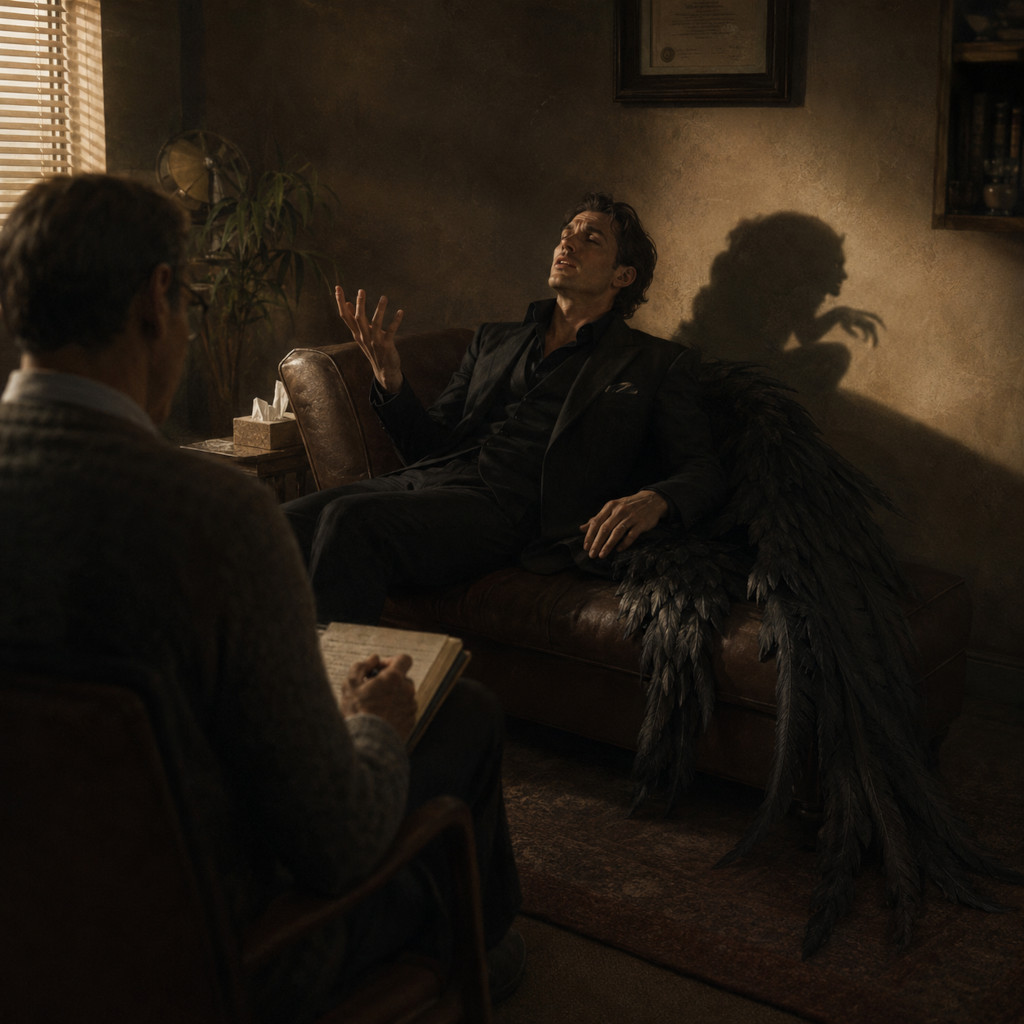 The Prince of Darkness is working on himself. His shadow already knows where this ends.
Almost ten years ago, on a train. I was coming back from a tabletop role-playing session1 with one of the players: a declared atheist, a good-natured man, solid in biology, curious about everything... and completely lost in theology, which did not stop him from discussing it with the quiet confidence of someone who has never opened the file. Somewhere in the conversation he laid out his view of things: the Devil is God's opposite number. The cosmic adversary. The boss of the rival firm. Two equal and opposing powers, Good and Evil in eternal balance, each with his own territory, each with his own clientele2.
I still remember his face when I answered him, in substance: "No, the Devil isn't some mighty figure. He's a poor bastard like you and me, except that he freely chose to be damned."
Silence. The look of a biologist confronting an unclassified species.
The man was not stupid, far from it. He was simply the product of a culture that has nothing left, to picture the Devil with, but images from fiction. And among those images there is one that has done very well these past few years, and that condenses just about everything it is possible to get wrong on the subject: the series Lucifer3. You know the one: the Prince of Darkness runs a piano bar in Los Angeles, solves cases with a detective, and sees a therapist to work through his issues with Dad.
I am not going to start by spitting on the show4. I am going to start by conceding everything it deserves.
Concession: the series asks the right questions
Let us be honest: Lucifer touches, without knowing it, on real theological questions. Why evil? Is the Devil a victim or a culprit? Can one hold a grievance against God? What is damnation? Can a father be good if he stays silent? These are serious questions, ones the Fathers of the Church and the scholastics turned over for centuries with infinitely more rigour than any Hollywood writers' room; but they are the right questions. And the show's success proves at least one thing: these questions still work on our contemporaries, even those who believe themselves rid of theology.
Better still: the show's Lucifer is precisely not presented as God's opposite number. He is a creature, a son, an aggrieved subordinate. On that specific point, the series is less wrong than my fellow traveller and his spontaneous dualism. Render unto Caesar5.
So much for the flowers. Now for the pot they came in.
An angel who doubts is not an angel
The televised Lucifer is a being who hesitates, evolves, discovers his emotions, makes progress in therapy, learns to love. It is touching. It is human.
That is exactly the problem: it is human.
For Saint Thomas6, the angel is a pure intelligence, without a body, without passions in the sense in which we undergo them, and above all without that discursive slowness which is ours. We poor bipeds reason step by step, we get things wrong, we revisit our choices, we convert: our knowledge is progressive and our will revisable. The angel, by contrast, sees at a single stroke everything there is to see in his object. His choice is not a bet made in the fog; it is an act posited in full daylight, with total lucidity about what he is doing and what it entails.
That is precisely why the angelic fall is irrevocable. Not because a resentful God would refuse forgiveness to a poor Lucifer who asked for it, but because the angel will never ask. There is nothing new he could learn, no experience that could change his mind, no "I didn't know" to plead. He knew. He chose. His choice is eternal as his intelligence is immediate. The demon's damnation is not a prison sentence of unlimited duration: it is the very fixity of a will that has given itself entirely, once and for all.
A demon who doubts, who gropes about, who matures, who does the work on himself, is therefore not a demon: he is a human being with wings and a standing appointment with a psychologist7. The series does not tell the story of an angel's fall; it tells the story of an immortal daddy's boy's midlife crisis. This is not blasphemy, it is a misreading. An important distinction: blasphemy presupposes that one has understood what one is talking about.
And here comes the Goddess (ugh)
But the summit is reached elsewhere. For in this series, God has a wife. An ex, no less: the divine couple is going through a cosmic marital crisis, and the children (the angels) are paying for it, as in any self-respecting blended family. Mummy Goddess escapes from the hell where Daddy had confined her after the divorce, and comes to stir up trouble in Los Angeles.
Let us stop for two seconds, because at this point we are no longer merely missing Christianity: we are missing monotheism altogether.
God, in the sense understood by three millennia of Jewish and then Christian thought, and singularly in the Thomistic sense, is not the beefiest of beings. He is Ipsum Esse Subsistens: Subsistent Being Itself, pure act, without composition, without genus or species, without potentiality, first cause of everything that is8. He is not a god, a remarkable individual in the category "deities"; he is that without which there are neither categories, nor individuals, nor anything at all. To append a "goddess" to him — that is, a partner of the same nature, a counterpart, another half — is to bring him back down to the rank of a being among beings, the male of a species that must surely need a female, like ducks9. This is no longer even an error about God; it is talking about something else while keeping the label. Zeus with a better-groomed beard.
And the God of the series is perfectly consistent with his Goddess: a distant father, manipulative, tight-lipped, with opaque "plans" and patent parenting failures. A limited demiurge one can judge, sulk at, psychoanalyse by proxy. In short: the ideal strawman of television-panel atheism. One understands why my fellow traveller imagined God and the Devil as competitors: that is exactly the God his culture had supplied him with. You cannot insult the God of the philosophers and the saints when you have only ever aimed at that failing paternal superhero.
Evil as trauma, or the end of freedom
The most revealing point remains. In the series, all of Lucifer's evil is explained. Childhood wound, parental incomprehension, an imposed role, a self-image degraded by millennia of bad press. Follow the therapy, trace the chain of causes back, and you will always find, at the origin, a suffering undergone. Evil is never willed; it is always inherited.
This is where my answer on the train takes on its full meaning, and where the classical doctrine is infinitely harsher, and infinitely more respectful, than the therapeutic version. The Devil is not a magnificent victim, nor a romantic rebel, nor a misunderstood soul. He is a creature who received being, intelligence, beauty, and who freely preferred his own nothingness. His misery is not a fate: it is a work. His work. The only thing he has ever really produced10.
And this is why the doctrine is paradoxically more respectful: it takes freedom seriously. To say that evil reduces to badly digested trauma is kindly on the surface, but it demotes the sinner, angelic or human, to the rank of a faulty mechanism that merely needs repairing. No more malice, no more refusal, no more drama: just psychic plumbing. Modernity believes it magnifies man by exculpating him; it diminishes him by stripping him of responsibility. Christianity, for its part, dares to say to each person: your evil belongs to you. That is terrible. It is also the condition for your conversion to belong to you.
What remains
The series Lucifer is therefore not a document about the Devil. It is a first-rate ethnographic document about what "God", "angel", "evil" and "freedom" still mean to a Hollywood screenwriter of our time. And the answer fits in three words: not very much. Even to contest transcendence, one must first shrink it into a family drama. It is the only language left.
My fellow traveller, at least, had the excuse of never having studied the question, and the honesty to listen to the answer. He made that face, then he asked further questions, and we had a real conversation. That is more than can be said for six seasons of television.
The Devil: a poor bastard, freely damned. God: Subsistent Being Itself, whom no goddess completes. And between the two, us: neither angels nor mechanisms, but free. Which is to say responsible. Which is to say convertible.
Notes
Yes, a Catholic who plays role-playing games. No, I summon nothing whatsoever around the table, except occasionally a pizzaiolo. The "RPGs = Satanism" case having been investigated in the 1980s by people who confused a d20 with a pentacle, I am dismissing it without further action.
My companion was unwittingly reinventing Manichaeism: Mani, a third-century Persian prophet, had built an entire system on this cosmic draw between Light and Darkness. The idea was wildly successful (it even held Saint Augustine for nine years before he slammed the door on it), and for good reason: it is comfortable. If Evil is a rival power, nobody is really responsible for anything, we are simply caught in the crossfire. Seventeen centuries later, people are still inventing Manis without the diploma.
Developed by Tom Kapinos from Neil Gaiman's character in Sandman, itself derived from the Lucifer of the DC comics. Gaiman's Lucifer was distinctly more interesting: at least he did not talk about his feelings.
Well, all right, a little. But methodically.
A rigorously appropriate expression in a piece about what one owes to God.
Summa Theologiae, Ia, q. 58 (the mode of angelic knowledge) and q. 64, a. 2 (the obstinacy of demons). As usual, the Angelic Doctor settled the whole thing 750 years ago, in a format shorter than one episode.
The therapist character, Linda, is in fact the most honest thing in the series: she spends several seasons treating her patient's literal confidences as metaphors. That is exactly what the entire series does with theology.
For newcomers: this is not a Latinist's affectation, it is the core of the reactor. For Saint Thomas, in every creature the essence (what the thing is) is distinct from the existence (the fact that it is). In God alone the two coincide: his essence is to exist. Hence the radical impossibility of a second copy, spouse or otherwise.
I am informed through my earpiece that some will see this as progress in matters of gender parity. I note in return that turning God into a duck, even a gender-balanced duck, is progress for nobody, and least of all for the ducks.
Evil being, in sound metaphysics, only a privation of being, a work of pure evil is a work of pure nothing. The Devil is therefore the ultimate conceptual artist: millennia of career, zero creation. Some will see this as a comment on contemporary art; I neither confirm nor deny.