
Pascal's Knockout Punch, or why the Wager isn't a used car salesman's scam
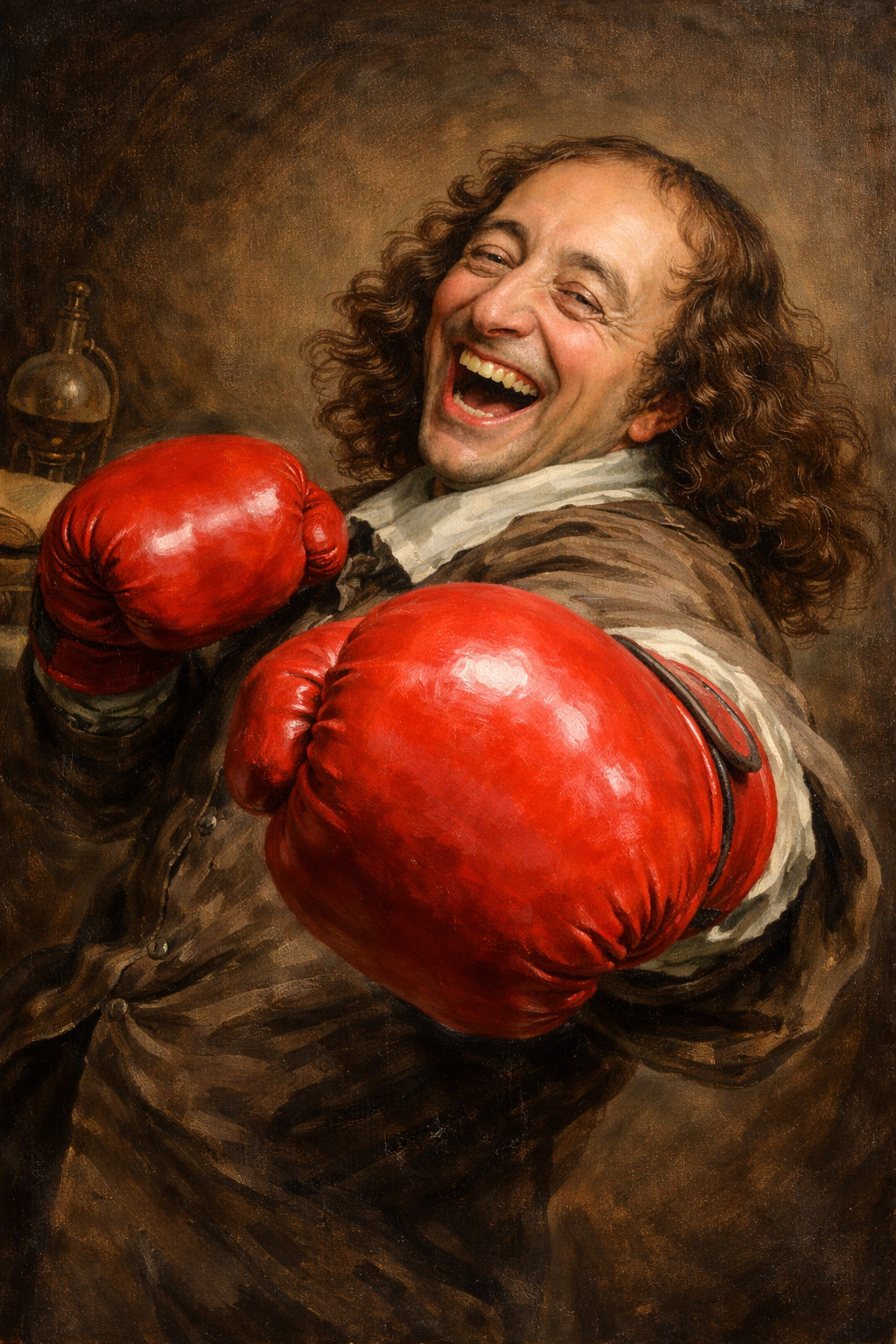
Take that, divertissement!
"Oh yeah, Pascal, he's the guy who says you should believe in God just in case? Like some kind of metaphysical life insurance?"
If I had a euro for every time someone trotted out this grotesque oversimplification, I could fund a critical edition of the Pensées bound in Cordoban leather. Pascal's Wager, reduced to a probability calculation for spiritual cowards. As if Blaise had spent his feverish nights churning out a brochure for some cosmic bookmaker.
No.
What you've been told about Pascal is, at best, a misunderstanding. At worst, intellectual slander. And I'm going to explain why, starting where it hurts.
The illness you don't want to see
Pascal doesn't start with God. He starts with you.
And his diagnosis is brutal. You're running away. Constantly. You chase after noise, activity, projects, distractions, screens, ambitions. Anything rather than being alone with yourself. Pascal calls this divertissement, and it's not a compliment. It's the name for your desperate flight from what you'll find if you stop: your misery, your finitude, and at the end, death.
"All of humanity's problems stem from man's inability to sit quietly in a room alone."
Try it. Tonight. Turn everything off. Sit down. Wait. How long before the anxiety rises? Before you reach for your phone, a book, anything?
Pascal saw right through you four centuries ago. You haven't changed.
The half-clever, or the trap of superficial intelligence
But wait. You're not one of those people who flee mindlessly, are you? You've thought about things. You've read stuff. You know that religion is for the simple-minded, the gullible, those who need crutches. You're above all that.
Pascal has a name for you: the half-clever1.
These are people who have thought enough to reject simple faith, but not deeply enough to understand why that faith exists. They despise rituals, dogmas, popular piety, because they only see the surface. They think intelligence means sneering. But they've never dug down to the bottom.
Pascal isn't opposed to intelligence. He's opposed to intellectual vanity, the kind that thinks it has seen through everything by skimming the surface. And he doesn't argue with these people: he humiliates them by revealing their incoherence.
Take the radical skeptics, for example. Those who claim we can't know anything with certainty. Pascal read them all: Montaigne, the Pyrrhonists, the whole catalogue. And he demolishes them in one sentence:
"The Pyrrhonist says he knows nothing, and gets upset when people don't believe him."
You can't live your skepticism. You act, you choose, you prefer justice to injustice. Your radical doubt is a parlor pose. Pascal tells you to your face.
The Wager: what it actually says
And here we are. The famous Wager. The one they presented to you as a probability calculation for cowards.
Let's reread it. Carefully.
Pascal isn't telling you: "Believe in God because it's safer." He's telling you something far more vicious: you're already betting. Every day. Every hour. By the way you live.
And there, he's got you cornered.
You say God doesn't exist? That man is just another animal, a biological accident in an indifferent universe? Fine. Pascal takes you at your word: then why don't you live like an animal?
Why don't you spend your days maximizing your pleasures? Why don't you sleep with everything that moves? Why don't you drink yourself into oblivion? Why don't you take whatever you can get, by force if necessary? That's what animals do. They follow their impulses. They know neither remorse, nor temperance, nor this strange idea of "dignity."
Oh, you tell me you're "reasonable"? That you're "protecting yourself"? That society works better with rules? Don't give me that crap. That's not prudence, it's weakness. You simply don't have the guts to follow your own logic to its conclusion.
Nietzsche, who was hardly a choirboy, understood this. He respected Pascal, "the only logical Christian," he said2. Because Pascal poses the problem without evasion: either you're truly convinced that man is just an animal, so live like one, embrace the beast to the end, become a magnificent wolf; or you already behave as if man were more than an animal, and in that case, where does this "more" come from?
See the trap?
You can't live your godless hedonism. You already behave as if life has meaning, as if some things are worthy and others unworthy, as if your choices carry weight beyond the simple mechanics of cause and effect. You're already betting on something that looks suspiciously like transcendence, but you simply refuse to give it its name.
The Wager isn't a calculation. It's a mirror. And what you see in it is that you already believe more than you admit.
The therapy for unbelief
But here's where Pascal gets really interesting, where most of his critics stop reading.
Suppose you're convinced. Intellectually, you see that the Wager holds. That reason points toward faith. But you can't believe. Something in you resists. Your hands are tied.
Pascal knows this problem. And his answer is stunning:
"Learn from those who were bound like you and who now wager all they have. Follow their way: act as if you believed, go to Mass, take holy water, live as if it were true. Even this will begin to heal you and draw you toward faith."
Unbelief isn't a purely intellectual problem. It's a disease of the whole person, of your passions, your habits, your will. And you don't cure an existential disease with arguments. You cure it by living differently.
This is where Pascal joins, perhaps unknowingly, the deepest wisdom of tradition: faith isn't primarily an intellectual assent, it's a practice. You don't believe and then act. You act, and belief comes. Or rather, it reveals itself to have always been there, buried under passions and flight.
Pascal's God: neither bookmaker nor watchmaker
A classic objection: "But Pascal opposes the God of Abraham to the God of philosophers! So he's anti-reason!"
Read more carefully.
What Pascal rejects isn't philosophy. It's lazy philosophy, the kind that uses God as a convenient cog in a system. He's targeting Descartes, who invokes God to guarantee that his method works: God reduced to a rubber stamp for a rationalist edifice. A domesticated, tamed, useful God.
Pascal hates that. Not because he despises reason, but because he takes it seriously. Seriously enough to see where it stops, and what lies beyond.
With Thomas Aquinas, it's different. Reason rises toward God as ipsum esse subsistens, the act of being itself, and points toward the living God, not toward an abstract concept. Pascal can respect that. His target isn't Thomistic metaphysics; it's the rationalism that thinks it has exhausted God by naming Him.
For Pascal's God, in the end, is the God of the Cross. A God who suffers, who loves, who dies. Pascal meditates on the Passion. He doesn't theorize, he weeps. Faith isn't a logical conclusion. It's a wound you must receive.
Thomas and Pascal: the duo that knocks you out
People sometimes ask me: can you be both Thomist and Pascalian?
I answer: you must be.
Thomas gives you clarity. Pascal gives you urgency. Thomas keeps you from error. Pascal saves you from indifference. One builds the cathedral. The other sets the altar on fire.
Imagine a boxing ring3. Pascal enters first: quick, sharp, circling you with irony, exposing your weaknesses, your laziness, your fear, your fake skepticism. You thought you were safe behind your ironic detachment? Bam: divertissement. You thought you were clever because you read Montaigne? Smack: half-clever. You're dazed.
Then Thomas steps into the ring. Calm, massive, inexorable. He grabs you by metaphysics, locks you in the four causes, pins you to the ground with the Five Ways. Everything leads to the Act of Being. You tap out.
Pascal breaks your ego. Thomas rebuilds your mind. One slaps you awake. The other gives you the world, ordered, intelligible, luminous.
You don't get to Heaven without both.
What Pascal is really asking of you
So, what to do with all this?
Pascal isn't asking you to believe because it's prudent. He's asking you to be honest with yourself. To look at how you live. To stop running. To recognize that your unbelief might not be a rational conclusion, but a disease. A disease of passions, habits, will.
And he offers you a remedy. Not another argument. A practice. Live as if it were true. See what happens.
"What have you got to lose?"
The question remains burning, four centuries later. In a universe you claim is cold, indifferent, absurd, full of chance, why do you believe love exists? That justice has meaning? That your life is worth something?
You're already betting. Every day.
Pascal simply asks you to look at what you're betting on.
Notes
The term is Pascal's. Those who have learned just enough to sneer, but not enough to understand. You meet them at every dinner party, and on every social network.
I maintain that the image of a wrestling tag-team is perfectly respectable for discussing the salvation of souls. Pascal would have loved it. Thomas would have sighed, then nodded.
Nietzsche, The Antichrist, §5. He adds that Christianity "corrupted" Pascal, but it's Nietzsche, he had to grumble about something.
The Pensées are available for free on Project Gutenberg. Read them like aphorisms. And brace yourself.