
Why Kant broke everything, or the worst rotten gem of all philosophical argumentation

We're in 1985. All of phi-
Sorry, wrong start.
I hate captious reasoning. One of my acquaintances recently pointed out to me, and rightly so, that being so stressed makes me easily adopt reasoning that appears attractive and true... without realizing it. I dedicate this post to them, and I hope to write more. Thank you, F.
We're in 1985. An Australian philosopher, David Stove, organizes a competition to find the worst argument in the world. He retains two criteria for this: first, how bad the argument is, in its own argumentation; and second, how influential it has been in the history of thought. In the end, he retained the following argument:
We can only know things if condition C, necessary for knowledge, is satisfied.
Therefore, we cannot know things as they are in themselves.
Bravo. Here is the most perfect gem in the entire history of philosophy. Have fun making a similar argument by replacing C with, your choice, one or more of the following conditions:
- in what form they appear to us;
- under the forms of our perception and understanding;
- insofar as they fall within our conceptual schemes;
- insofar as they enter our minds;
- insofar as they are conceptualized by means of concepts;
- insofar as they are formulated in language;
- insofar as they are mediated by society or culture.
Stove proposes an argument of the same level:
We can only eat oysters insofar as they are brought into physiological and chemical conditions that are the prerequisites of our consumption of oysters.
Therefore, we cannot eat oysters as they are in themselves.
That's brilliant. We cannot eat oysters without eating them. Impressive. We cannot know something without knowing it. This argumentative gem raises questions that seem deep, really deep... and once you've looked at them carefully, you realize how irrational these questions are. Basically...
What would it be like to know something...
without knowing it?
Whoa.
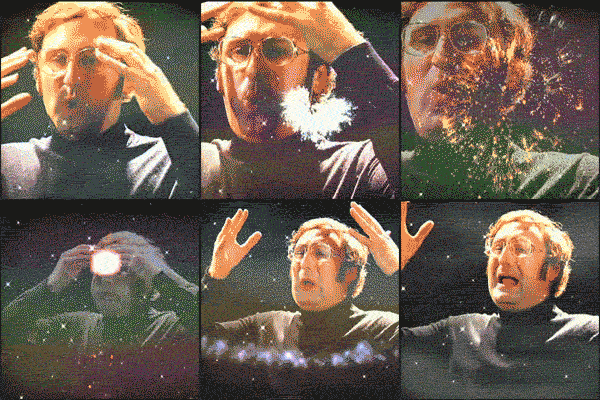
Since Descartes, philosophy loves this kind of gem. Descartes paved the way well, magnificently posing "but how can one 'get out' of one's mind, get out of one's 'sphere of subjectivity' and know the 'true objective external world'". Seeing the impasse he had created for himself, Descartes imagined a solution by posing a shaky mix of divine intervention and pineal gland1.
The magical train of thought more or less followed this kind of thinking until a somewhat audacious Scotsman, David Hume2, set fire to the Enlightenment with his acid skepticism. Kant, seeing this, rather than having the good sense to let the pyre finish burning and return to Aristotle, doubled down instead, with a magnificent gem.
We cannot escape our own sphere of mental experience, because in fact our minds CREATE the world (since we experience it), which means we can know NOTHING of the world as such.
Basically, Kant had replaced knowledge with "KnOwLeDgE", and never explained how he knew that we only had "KnOwLeDgE" and not knowledge... well, except for his gem:
Our knowledge of the world is our knowledge;
Therefore, it's not knowledge of the world, just "KnOwLeDgE" of the "WoRlD".
Seeing this, Nietzsche, rightly and mischievously, arrives with his heavy boots, and completely ignores Kant's tearful pleas to stop thinking. Indeed, Kant suspected that if his critical project were pushed a little too far, it would explode from contradiction -- his "solution" was simply not to go too far, and to tell everyone not to think too much. Fortunately, everyone more or less ignored him -- even Fichte, Schelling and Hegel.
In Nietzsche's tank, we more or less crush everything that moves except Kant's conclusion: "we create the world". All philosophy, notwithstanding Socrates, Plato and Aristotle, then becomes poetry, rhetoric and sophistry contests.
Our fine modern speakers of the 20th century, arriving wearing their magnificent postmodernism, quickly assault and introduce this drama into language... let's cite Derrida, Foucault, or even old Wittgenstein:
We can only speak of things through language, therefore, we cannot speak of things!
From there comes the magic of philosophy rotten by this gem: as soon as we reject the idea that we can know things (dear to Plato and Aristotle), we no longer know anything, and we can no longer say anything. Kant must know that he can only "KnOw" and not know, but he can't know it since by his own admission, he can only "KnOw"; Derrida tells us that everything is just text interpretation, but it's not true, only Derrida's text interpretation; Foucault and his contemporary companions tell us that all theory is just a power construction, but that only means Foucault's theory is just a power construction, not the truth of things. And so on, ad infinitum.
Anyway. If someone tells you they "KnOw" (or know) that we can't know things, look for this rotten gem, it's not far3.
Notes
We can see, today, that this solution works perfectly. /sarcasm
For once I have a positive comment about him...
Remember, however, Aristotle's ultimate maxim: "One doesn't argue with a houseplant." (or a skeptic, depending.)