Requiem for New Atheism, or the eulogy of an enemy we didn't deserve
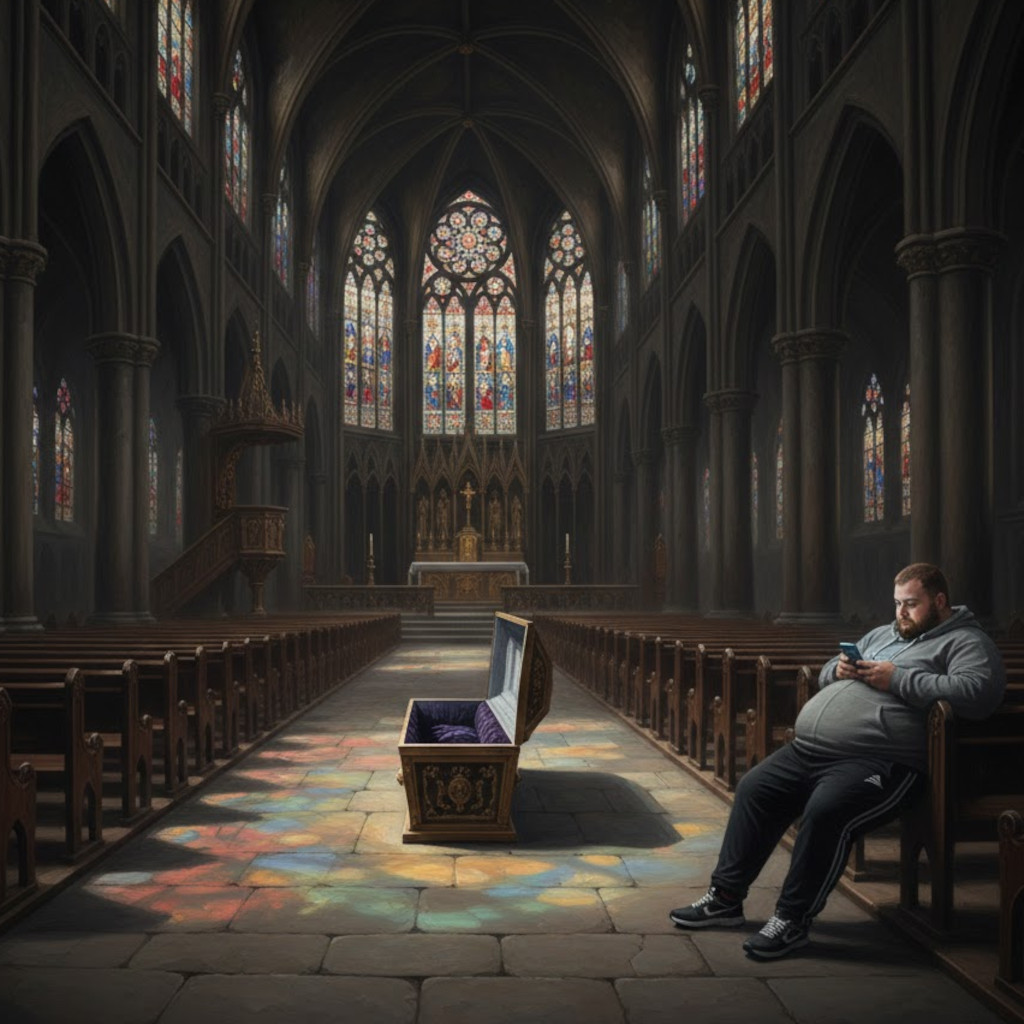 An empty gothic cathedral, an open coffin in the middle of the nave, and a pot-bellied man slumped on his phone. The entirety of New Atheism summarized in one image.
I have a confession to make, and it will surprise you: I miss New Atheism.
Not its conclusions, obviously. Not its cramped materialism, nor its triumphant scientism, nor its reading of religion with boxing gloves and a blindfold. No. What I miss is the effort. The ambition. The magnificent insolence of people who at least had the courage of their errors.
Because New Atheism, whatever one says about it, tried. It tried to build an intellectual edifice. It failed, certainly, and sometimes spectacularly, but it failed while thinking, which is infinitely more respectable than what replaced it: a soft, pot-bellied, self-satisfied atheism that no longer thinks at all and congratulates itself for it.
The golden age of worthy adversaries
Let us remember. There was Dawkins, with his God Delusion, which at least had the merit of provoking serious responses (Plantinga, Hart, Feser). There was Hitchens, whose prose was so beautiful you almost forgave him for being wrong about everything. There was Harris, who asked real questions about morality, even if his answers were of a philosophical naivety that would make you weep. And there was Dennett, the only one of the lot with genuine philosophical training, and whose errors were therefore the most interesting.
The "Four Horsemen." We smile today, but they rendered an immense service to Christian theology, without wanting to and without knowing it. They forced us to sharpen our arguments. They compelled us to reread Thomas Aquinas, to understand why the Fifth Way is not Intelligent Design, to explain why "who created God?" is not an objection but an admission of incomprehension. They were, in the strict sense, our best sparring partners.
Dawkins forced me to read Feser. Hitchens forced me to reread Chesterton. Harris forced me to understand natural law. And Dennett forced me to take Thomistic philosophy of mind seriously. Without New Atheism, I would be at best agnostic, at worst a sacristy Catholic who recites the Creed without understanding a blessed word of what he's saying. It was my adversaries who taught me how to fight. And I am, sincerely, grateful to them.
What killed New Atheism
New Atheism was not defeated from the outside. It collapsed from within, as every position built on a performative contradiction eventually does. You cannot use reason to deny the foundations of reason. You cannot invoke truth to say there is no truth. You cannot do metaphysics to say that metaphysics is hot air. And the New Atheists, by pulling on these threads, ended up hanging themselves with them.
But there were also less noble causes. The movement fragmented over political and cultural questions that had nothing to do with the existence of God. Dawkins became a culture wars commentator. Harris lost himself in meditation and podcasting. Hitchens died (and the intellectual world was impoverished by it, whatever one thinks of his theses). Dennett died too, and with him the last one who knew what he was talking about when he talked about philosophy.
And what remains? A desert.
The return of soft atheism
What replaced New Atheism is not another atheism. It is an absence of atheism. An intellectual void that mistakes itself for a philosophical position. A shrug elevated to doctrine.
The soft atheist doesn't think that God doesn't exist. He doesn't think anything at all. He "doesn't believe," the way one doesn't collect stamps: by simple absence of interest. If you ask him why, he looks at you with that vaguely condescending air of someone who thinks the question was settled in the eighteenth century and doesn't know exactly by whom or how, but it's settled, he's been told. He has read neither Dawkins nor Thomas Aquinas, neither Nietzsche nor Aristotle. He read a meme on r/atheism and that's enough for him.
This is the atheism of "no evidence." Of "the burden of proof is on you." Of "I'm actually agnostic" (pronounced with the tone of someone who has just solved a millennial problem by declaring himself neutral). It's an atheism that doesn't even know it is an atheism, that believes itself a default position, a degree zero of belief, when it is, like every position on the existence of God, a metaphysical commitment that demands justification.
The museum of worn-out clichés
Let us inventory the relics. We encounter them daily, on Reddit, on Twitter, at dinner parties, delivered with the same unshakeable conviction as if they had just been invented.
"Who created God?" The grand classic. The undethroned. The one that returns every three hours on r/DebateAnAtheist with the freshness of discovery. I've already discussed this elsewhere, but let's repeat it, since apparently it must be repeated until the end of time: the cosmological argument does not say "everything has a cause." It says that every contingent being requires a cause. God, by definition, is not contingent. Asking "who created God?" is asking "who is the married bachelor?" It's not an objection. It's proof that one hasn't understood the argument one claims to refute.
"No evidence!" This one is magnificently naive. "There is no proof of God's existence." Really? None? Not the Five Ways of Thomas Aquinas? Not Anselm's ontological argument? Not the moral argument? Not the argument from contingency? Not the argument from sufficient reason? Not the teleological argument? "No, no empirical evidence." Oh, pardon me, the rules of the game have been changed without notice. It was decided a priori that only empirical evidence counts, which excludes by construction a being that is not empirical, and then one triumphs at not finding him. It's looking for your keys only under the streetlight because that's where the light is, then concluding that the keys don't exist.
"Science has proven God doesn't exist!" No. Science has proven no such thing, because science cannot prove any such thing. Science studies natural phenomena through the empirical method. God, if He exists, is not a natural phenomenon. Asking science to prove or disprove God's existence is asking a thermometer to measure justice. The instrument is not designed for that. Confusing the limits of the method with the limits of the real is the microscope sophism, and I devoted an entire article to Monod to show where that leads.
"I'm actually agnostic." The refuge position. The Switzerland of metaphysics. "I don't know if God exists, so I suspend my judgment." Very well. But notice that this position, presented as intellectual modesty, is in reality a luxury that nobody grants themselves in any other domain. Nobody is "agnostic" about whether the Earth is round. Nobody "suspends judgment" on the existence of the external world. Agnosticism, when sincere, is a starting point. When claimed as a destination, it's laziness disguised as prudence.
"Religion is responsible for all wars." Even Hitchens, who served this one with talent, knew it was a gross exaggeration. Both World Wars, Soviet communism, Maoism, Pol Pot's Cambodia: none of this had anything whatsoever to do with religion. Twentieth-century atheism produced more deaths in fifty years than all the wars of religion in five centuries. This is not an argument for theism (the truth of a proposition does not depend on the behavior of those who defend it), but it is an argument against the dishonesty of those who brandish the Crusades while forgetting the Gulag.
So much for the clichés. But these are merely symptoms. The disease lies elsewhere, and it is far more serious.
The puppet of nihilism
Contemporary soft atheism, particularly in its French variant, is not a philosophical position. It is a nihilism that dares not speak its name.
Watch it live. The soft French-style atheist despises life but calls himself a humanist. He hates suffering, not because he has a theory of the good that would allow him to say why suffering is bad, but because suffering disturbs him, personally, in his comfort. He doesn't want life to have meaning, because meaning would impose demands, and demands are tiring. He prefers the cozy nothingness of a purposeless universe, where nobody will ask him to get off the couch and become better. His atheism is not a conclusion: it is a resignation. It's not "God doesn't exist"; it's "I hope God doesn't exist, because otherwise I'm going to have to change my life."
And the most comic, the most tragically comic thing, is that he can't even hold his own framework for five minutes. Watch him when something really touches him. When he hears of an injustice, he is outraged. When a child suffers, he says it's wrong. When he's lied to, he demands the truth. When he falls in love, he speaks of meaning. And every time, with every sincere emotion, he borrows from theism the very categories he claims to have abolished. Good. Evil. Truth. Dignity. Justice. None of this has any foundation in a materialist universe, none, zero, and he knows it dimly, and that is precisely why he doesn't want to think about it. Thinking would mean pulling the thread, and the thread leads somewhere he refuses to look.
It's a comfort nihilism. A part-time nihilism. A nihilism that denies the meaning of the universe in the morning and is outraged by injustice in the evening, without seeing the contradiction. A nihilism that scorns metaphysics but does metaphysics every day, like Monsieur Jourdain spoke prose, except that Monsieur Jourdain at least had the excuse of not having read Aristotle.
And the laziness. Good Lord, the laziness. The soft atheist doesn't work on his positions. He doesn't read. He doesn't seek. He doesn't confront anything. He repeats what the ambient consensus whispers to him, with the docility of a parrot and the assurance of a pope. Tell him that Thomas Aquinas demonstrated the existence of God, he'll reply "that's been refuted" without knowing by whom or how. Tell him that eliminative materialism is self-contradictory, he'll reply "LOL." Tell him that objective morality requires a metaphysical foundation, he'll reply "you don't need God to be moral," which is true on the practical level and catastrophically false on the philosophical level, but he doesn't know the difference because he never bothered to look for it.
This is the atheism that dominates in France today. Not Sartre's, who at least had the courage to look nothingness in the face and draw the consequences. Not Camus's, who at least wrestled with the absurd instead of wallowing in it. No. A shopping-mall atheism. An atheism that believes in nothing but buys everything. An atheism that is, at bottom, the intellectual form of laziness, and the spiritual form of despair.
A eunuch's battles
And look at what this modern atheism fights for. Look at its causes, its crusades, its outrage. Everything is reduced to the social. Everything is reduced to the political. As if society and politics were absolutes, ultimate ends, unsurpassable horizons of human existence.
The soft atheist has no more metaphysics, so he makes the social his metaphysics. He has no more transcendence, so he makes the political his transcendence. And with what does he defend these new absolutes? With constructivism. With subjectivism. That is to say, with tools that, by definition, deny the existence of any absolute. He decrees that gender is a social construct, that morality is relative, that truth is a power relation, then he is absolutely outraged when someone contests his constructions. He is a man sawing off the branch he's sitting on, who falls, and accuses gravity of sectarianism.
His battles are feeble. I'm not saying they're all wrong (some touch on real questions), I'm saying they are pitiful in the etymological sense: they inspire pity, because they are waged without foundation, without a spine, without anchorage in anything resembling a truth. The soft atheist falls in behind the flabby majority of the moment, whichever it may be, and calls that "progress." He confuses the direction of the herd with the direction of history, and the direction of history with the direction of the good. Three errors in one sentence. That takes talent.
The garden of Epicurus, Uber Eats edition
At bottom, we are exactly in what that fat pig Epicurus was extolling twenty-three centuries ago: a life where you don't push yourself too hard. Where you avoid pain. Where you maximize quiet little pleasure. Where selfishness is rebranded "wellness." Where the highest ambition is ataraxia, that is, in modern language, the peace of the man who couldn't care less about anything. The ideal of the soft atheist is Epicurus's garden, except that Epicurus at least cultivated his garden. The soft atheist orders sushi on Uber Eats and watches Netflix. You reap what you deserve: low-grade glories. Getting the milk from the corner shop. Finding a parking spot. Managing to assemble an IKEA shelf without leftover screws. These are the summits of existence when you've decided that existence has no summit.
But man is a religious animal. Chase the sacred out the door, it comes back through the window, and in far worse form. The soft atheist, having emptied the sky, fills the void with whatever he finds, which is to say, with anything at all. And the spectacle of his replacement idols is, it must be said, heartbreakingly sad.
There is consumerism, the most widespread and stupefying idolatry. The compulsive accumulation of objects, experiences, Instagrammable "moments" in lieu of meaning. You buy a phone, you feel a thrill of fullness for three days, then the void returns, so you buy something else. It's the Danaids' barrel, Amazon Prime edition. Saint Augustine diagnosed the thing sixteen centuries in advance: "You have made us for Yourself, O Lord, and our heart is restless until it rests in You." The soft atheist reads this sentence and finds it pretty. Then he opens another order page.
There is transhumanism, the most pathetic of substitutes. The idea that technology will save us from the human condition. That if we cannot ascend toward God, we can at least become gods ourselves, through nanotechnology, artificial intelligence, and cryogenics. It's original sin in business plan form. "You shall be as gods": the serpent's promise, reformulated as a Silicon Valley startup pitch. The transhumanist doesn't want eternal life given by a loving God; he wants eternal life stolen by autonomous technology. It's Prometheus, but without the fire and without the liver: the vulture remains, now calling itself "disruption."
And there is starivism, this disease that doesn't even have an official name in the manuals yet but deserves one. The idolatry of personalities. Man needs models, examples, figures to look up to. He had the saints. He now has influencers. He had Teresa of Avila, Francis of Assisi, Thomas More. He now has a YouTube entertainer who does "pranks," a reality TV contestant who tells his love life to three million people, a third-rate politician whose opinion on everything fits in a tweet, and a billionaire who launches cars into space to feel alive. People dedicate their lives, literally their lives, to following these characters, commenting on their every move, drawing inspiration from them, defending them the way one once defended one's patron saint. The reality TV fan knows the names of his idol's children but doesn't know the Beatitudes. He weeps hot tears when his favorite YouTuber announces a break, and has never shed a tear before the Crucifix. It's idolatry in the most technical sense of the term: rendering to a creature the worship owed to the Creator. Except that the old idols, at least, were made of gold. These ones are made of pixels.
Consumerism, transhumanism, starivism, and more besides (eroticism elevated to an absolute, wellness as religion, "self-actualization" as the unsurpassable horizon), all of this is the logical, inevitable, mechanical result of a world that chased God away and discovers with stupefaction that the God-shaped hole doesn't fill with gadgets. Chesterton was right: "When a man ceases to believe in God, he doesn't believe in nothing, he believes in anything." Here we are. The "anything" has arrived, and it has a TikTok account.
Choose life
And inevitably, at the end of this road, there is the question. The question. The one Camus called "the only truly serious philosophical problem." Is life worth living?
The soft atheist, faced with this question, whimpers. He has no answer. He cannot have one, because within his framework, the question literally has no meaning: if life has no finality, if existence has no purpose, if good and evil are conventions, then the question "is life worth it?" is as absurd as "is blue square?" And yet he asks it. And it gnaws at him. And he manufactures podcasts, self-help books, meditation apps, an entire industry of "meaning" to fill a void he himself dug by declaring that meaning didn't exist.
So allow me, in the face of this whimpering, a good metaphysical kick in the rear.
The answer exists. It fits in two words. They are not mine, they are older than Greek philosophy, and they have crossed thirty-three centuries without aging a day:
"Choose life."
Deuteronomy 30:19. Moses before the people of Israel: "I have set before you life and death, blessing and cursing: therefore choose life, that both you and your seed may live." This is not a suggestion. This is not self-help advice. It is a commandment, and it presupposes exactly what the soft atheist denies: that life has objective value, that it deserves to be chosen, that there is a real good to turn toward and a real evil to turn from. Choose life. Not comfort. Not ataraxia. Not Pascalian diversion. Life, in all its demands, all its pain, all its splendor.
The soft atheist cannot choose life, because he has spent his life denying there is anything to choose. The Christian chooses. And this choice, this act of the will illuminated by the intellect, is the first step out of Epicurus's garden and toward something that finally deserves the name of life.
The mirror: low-quality theism
But I would be dishonest if I didn't turn the mirror around. Because soft atheism has a twin brother, and he lives in our ranks: soft theism. Fideism. The faith-that-doesn't-need-reasons. And it is, in its own way, just as devastating.
"I know it in my heart." No. You don't "know" anything in your heart. Your heart is a muscle that pumps blood. What you call "knowing in the heart" is a feeling of subjective certainty, which is exactly as reliable as the feeling of subjective certainty of the Buddhist, the Muslim, and the man who's sure his lottery numbers are going to come up. Feeling is not an argument. The Catholic faith is not a feeling: it is an assent of the intelligence to a revealed truth, sustained by grace. It is an act of the intellect, not a tingle.
"Faith doesn't need proof." Wrong, wrong, utterly wrong, and dangerously wrong. Faith, according to Saint Thomas, is an act of the intelligence moved by the will under the impulse of grace. It is not against reason, it is beyond reason, which is not at all the same thing. Faith without reason is fideism, and fideism is a heresy. Literally. The First Vatican Council solemnly defined that the existence of God can be known by natural reason. If you say faith doesn't need proof, you are no more Catholic than Monod: you're just making the opposite error.
"You can't prove God." Yes. You can. Thomas did it. Five times. And if you don't understand how, it's not a problem of proofs, it's a problem of education. The cosmological argument, the argument from contingency, the teleological argument, the argument from degree, the argument from governance: all of this is rational demonstration, accessible to natural reason, without recourse to Revelation. To say "you can't prove God" while being Catholic is to contradict the Magisterium. It's not humility, it's ignorance.
"It's a matter of faith, not reason." This is exactly the gift you give the soft atheist. You tell him: "You have reason, I have faith." And he leaves delighted, confirmed in the idea that religion is an irrational sentimentalism for fragile people. Bravo. You have just betrayed two thousand years of Catholic intellectual tradition, from Augustine to Thomas to Newman, for the price of a hollow phrase that saves you from reading the Summa.
The strange symmetry
Do you see the pattern? The soft atheist says: "I don't believe, and I don't need reasons." The soft theist says: "I believe, and I don't need reasons." Both agree on the essential point: reason has nothing to do with it. And both are wrong, symmetrically, magnificently, desperately.
New Atheism, at least, refused this symmetry. It demanded reasons. Bad reasons, certainly, but reasons nonetheless. It took the question seriously. It treated the existence of God as an intellectual problem worthy of confrontation, not as a cultural trivia item to be filed under "personal preferences" between veganism and astrology.
And that is precisely why it was dangerous, and precisely why it was useful. An adversary who thinks forces you to think. An adversary who shrugs invites you to do the same. And the Church has never progressed by shrugging.
What we have lost
With the death of New Atheism, we lost something precious: an interlocutor. Someone to respond to. Someone whose errors were sufficiently structured that they could be dismantled properly, and whose dismantling advanced understanding.
Today, whom do we respond to? Memes. Slogans. People who say "LOL sky daddy" and think they've contributed to the philosophical debate. People who have never heard of the Five Ways but are absolutely certain they've been refuted. People whose most sophisticated argument is "extraordinary claims require extraordinary evidence" (delivered with the confidence of someone who believes Carl Sagan invented epistemology).
This is not a fight. It's a monologue before an empty hall.
The final word
I don't regret the death of New Atheism as a system. It was structurally false, and it had to fall, because eliminative materialism is an untenable position and scientism is an epistemological suicide. What I regret is the intellectual energy it channeled. The rigor it demanded. The seriousness with which it took the ultimate questions, even to give them bad answers.
We need better enemies. And, more urgently still, we need better allies. Soft atheism will not be defeated by soft theism. It will be defeated, if it must be, by hard Thomism: rigorous, demanding, charitable, and ruthlessly honest. A Thomism that does not retreat before objections, that does not take refuge in sentiment, and that has the courage to say, to the atheist who shrugs: "Sit down. We're going to start from the beginning. And this time, we're going to think."
Saint Thomas Aquinas always began with the objections. The strongest ones. The most dangerous. He never spared himself. If the greatest theologian in history had that humility, you can surely make the effort to understand your adversary's argument before brandishing your rosary.
And to my atheist friends, if you're reading this: come back. Not to faith, not yet, that's between you and God, and He is patient. But come back to thought. Take up the arguments again. Ask the real questions. Demand answers. Frighten us. You make us stronger when you try to knock us down, and you make us weaker when you shrug.
Atheism deserves better than what it has become. And theism does too.
So you, the soft atheist, you who have been shrugging since the beginning of this article, you who think yourself above the fray because you never deigned to enter it: come. Come take your kick in the rear. So you can give me one back. But for that, you'd have to produce something other than diversion1, and act beyond the pot-bellied beast that you are, you and your friend the soft theist. You make quite the pair: he believes without thinking, you don't think without believing, and meanwhile Pascal is laughing in his grave because he diagnosed you both four centuries ago. You are a demi-habile: you've read just enough to despise faith, but not enough to understand what you despise. You sneer at dogmas the way a tourist sneers at a language he doesn't speak. He, the soft theist, is a simple who refused to grow up: he has the faith of the coal miner without the coal, humility without the work, certainty without comprehension. And both of you are champions of diversion: you flee the question, he into his sentimentalism, you into your irony, and neither of you has the courage to sit for five minutes before the abyss and look into it. Pascal would have looked at you both with that glacial pity that belongs only to him, and he would have said: "All of man's misfortune comes from one thing, which is not knowing how to sit quietly in a room." You don't even have a room. You have a news feed.
Diversion in Pascal's sense, not Netflix's (though that too). See my post "Pascal's Sucker Punch, or why the Wager is not a carpet-seller's scam." Pascal understood, four centuries before recommendation algorithms, that man prefers any noise to the silence in which he would hear the truth.