Why Simon stays at the bottom of the sea, or SOMA, the horror game that only frightens materialists
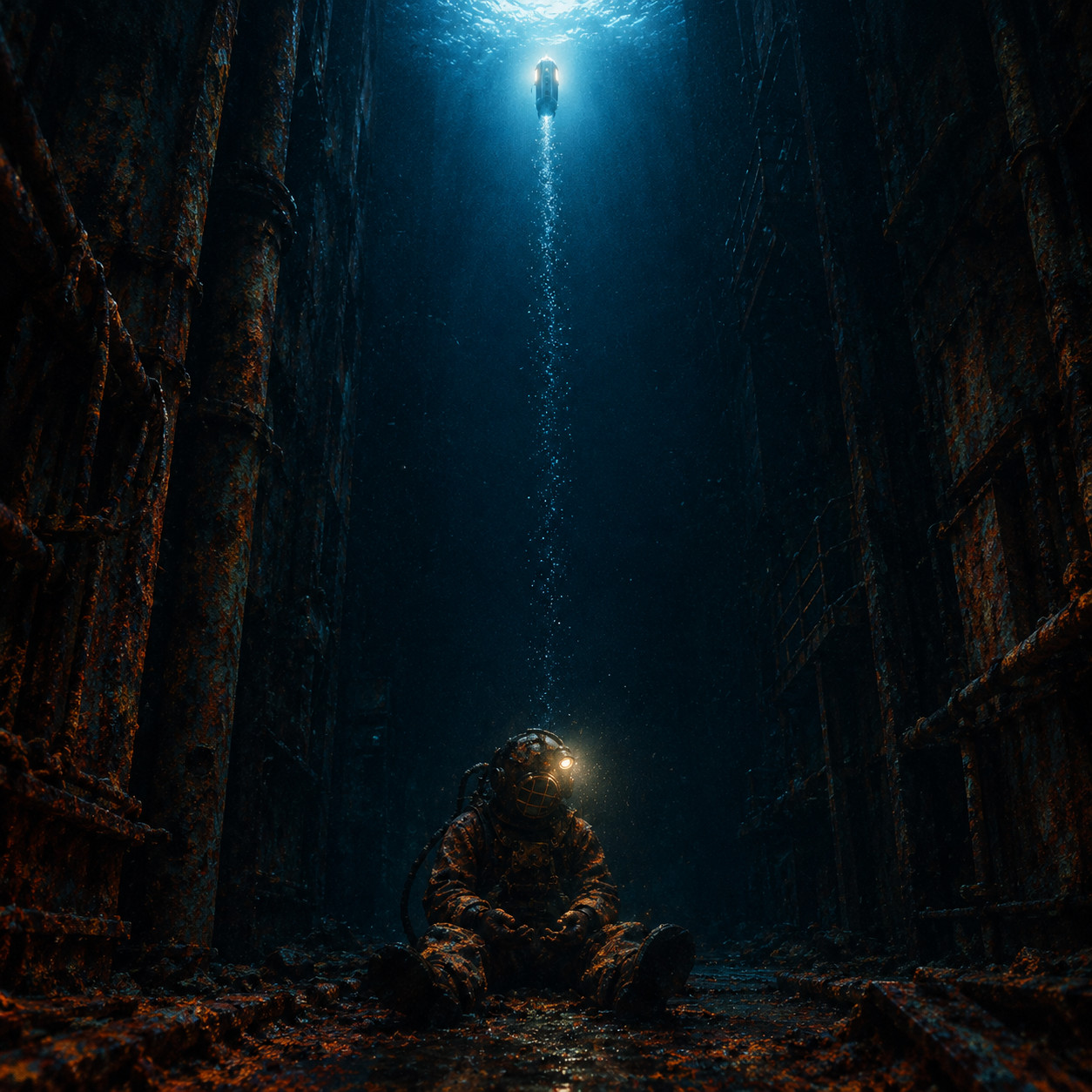 The capsule has left. He stays.
"Simon, you're on the ARK."
You are at the bottom of the Atlantic, in an abandoned station, a few metres from a capsule that has just left for the stars with paradise inside it. You have just pressed the button. You are waiting to wake up on the other side, in the light, on a synthetic beach where nobody dies any more. You do not wake up. You are still here, in the dark, with a failing battery and a colleague in your headset explaining, patiently, that it worked: the other Simon got there safely. Not you. You stay.
That is SOMA, the game Frictional Games released in 20151, and that is why it frightens people. Not because of the monsters (they are bad, we will come back to that) but because of that final scene, which is, to my knowledge, the only philosophical thought experiment you are made to play in the first person all the way to its conclusion, and whose conclusion is that you have lost.
I have a confession to make before going further: I was not afraid. I played SOMA late, with the reserve of a man whose job is to build machines that imitate scraps of cognition, and who therefore knows just how far the imitation is from the thing; I finished the game, shrugged and went to bed. Meanwhile, the forums were telling another story: weeks of insomnia, "existential crises", people who no longer dared look at themselves in a mirror. At first I thought I was jaded. Then I understood that the difference was not one of courage but of premises. SOMA is a horror game with a single audience: it terrifies only those who believe what it believes, and that happens to be more or less everyone, except Thomists. I expected a transhumanist sermon with seawater. I got a transhumanist sermon that, at the last moment, refuses to believe itself, and leaves the player holding the corpse of its own thesis. That corpse is what I would like to examine, and that is why I shrug: I had seen it before.
Render unto the game what is the game's
Let us begin with the concession, and make it generous, because it is deserved.
SOMA is a good game. Not a good horror game (the creatures are old stock recycled from Amnesia, and the developers understood this so well that they added a safe mode in which the game loses next to nothing2), but a good piece of fiction, the kind that knows where it is going. The plot fits in a sentence: Simon Jarrett, a Torontonian injured in a car accident in 2015, agrees to an experimental brain scan, and wakes up in 2104 in an underwater station off Greenland, PATHOS-II, after a comet has sterilised the surface of the Earth. He is, without knowing it at first, a ninety-year-old file running inside a dead woman's body. The rest of humanity, or what is left of it, has a project: the ARK, a small simulated world into which the scans of the last survivors are loaded, and which is to be launched into orbit so that "humanity" may go on. Simon and Catherine, his only companion (herself a scan), cross the station to go and launch the capsule.
Let us grant next that the game's thesis is honest, and that it is everyone's. SOMA is built, without naming it, on what philosophers call functionalism, and more precisely on its patternist variant: a person is a pattern, a sufficiently fine-grained organisation of information; the substrate (neurons, silicon, structure gel) does not matter; to copy the pattern is to copy the person. It is the implicit metaphysics of the whole of Silicon Valley, of half of popular neuroscience, and, I fear, of most of the players who pick up the controller. Nobody taught it to them; they were made to breathe it. "You are your brain", "you are your memories", "consciousness is software": nobody has examined these sentences, they are the scenery.
Let us grant finally, and this is the concession that costs a Thomist the most, that the game makes this thesis desirable. The ARK is presented as good news, the only good news left. Catherine believes in it. The player believes in it. For three quarters of the adventure, we accept without flinching that Simon is "really" Simon, and I know of no player who put down the controller at the first transfer saying "wait, that doesn't work". The game wins our consent. That is precisely why what follows hurts.
There is no coin toss
Simon is copied three times. In 2015 first, in the scanner's chair. Then in 2104, from a dead woman's diving suit into a sturdier one, to go down into the abyss. And at the end, from the suit into the ARK. Each time, the game does the same thing, and this is its stroke of genius: it leaves you on the side of the one who stays.
At the second transfer, you wake up in the new body, you turn around, and the old Simon is sitting there, inert, still switched on. Catherine suggests you unplug him. You can do it. You can also let him wake up alone, in a dead station, wondering why the transfer failed. The game does not decide. Then, at the third transfer, you are the old one. The exact mirror image of what you have just done to the other.
Catherine has an explanation for this asymmetry, and it is the most important passage in the game, because that is where it lies. "It's a coin toss," she says. You could have landed on either side; you landed on the wrong one. She says it gently, and the player, as a rule, accepts it, because he wants to believe it and because the vocabulary of probability sounds serious.
It is false, and false in the most elementary way possible. A coin toss presupposes two outcomes for a single coin. Here there is not one coin, there are two. Nothing has been tossed. The scan is read, the pattern is written elsewhere, a second Simon switches on, the first carries on exactly as before. There is no outcome in which the original "ends up" in the copy; in one hundred per cent of cases the original stays where he is. Simon has run the experiment three times and, three times out of three, the result was the same. Catherine knows it; she has seen the previous scans, she has seen Simon-2 unplug Simon-1. Her "coin toss" is not a theory, it is a sacrament of consolation, the last rite of a godless religion administered to a dying man3.
The game itself knows, moreover, that the coin toss is rigged, and it says so through its secondary characters. Before Simon's arrival, part of the PATHOS-II crew followed a certain Mark Sarang, who preached "continuity": to be sure of ending up on the ARK, you must die at the very instant of the scan, so that there are never two Simons at once. His disciples therefore killed themselves on the scanning table. Look closely at what Sarang does: he does not solve the problem of the copy, he eliminates the plaintiff. If the scan really were you, there would be no reason to kill the original; the original is killed precisely because everyone knows he will stay, and that he will complain. The doctrine of continuity is the admission, by its most fervent faithful, that copying is not moving, and that a corpse is needed to keep up the illusion4.
And here is the point: this lie is the proof that the game knows. SOMA laid down the patternist thesis, played it out to the end, and obtained a refutation by absurdity, what the scholastics call a reductio ad absurdum, that is, showing that a premise is false because it leads to an impossible consequence. The premise: the scan is you. The consequence: then both are you. The impossibility: you are manifestly one, the one dying at the bottom of the sea while the other sunbathes. Therefore the scan is not you. The demonstration is complete, it is played in the first person, and the game ends it with a lie instead of the conclusion. We should not hold this against it; we should be grateful. Few philosophical theses have the honesty to refute themselves on screen.
The engineer in me adds a more down-to-earth remark. What the scanner produces is not Simon, it is a description of Simon, fine-grained enough for a computer to execute. A description, even a perfect one, is not the thing described; a weather model, however fine, gets nobody wet. The game confuses simulating and being, and that confusion is as old as Leibniz and his mill5: walk into the thinking machine and you will see only parts pushing one another. Nobody ever answered Leibniz; people merely stopped reading the question.
Anima mea non est ego
What does a Thomist say to Simon? He has a sentence ready, and it is more brutal than one might expect.
Saint Thomas, commenting on the First Epistle to the Corinthians, writes: anima mea non est ego, "my soul is not I"6. He is not talking about a file; he is talking about the separated soul, that is, what subsists of a man after death, and which is nonetheless infinitely more than a pattern of information, since it is a subsistent form capable of knowing and willing. Even that, says Thomas, is not the person. The person is the union of this soul and this body; the soul alone is a fragment that waits, not a man. If my soul is not I, all the more so the survey of my synapses is not. Thomism does not need to invent an objection to SOMA; it wrote it seven centuries ago.
Why? Because for Thomas, as for Aristotle, the identity of a living being is not an abstract form but a substance: a form of this matter here. The soul is the form of the body, forma corporis, what makes this heap of matter a man and not a corpse; but it is the form of this body, and it is matter that individuates. Two statues from the same mould are two statues, not one statue in two places. Two instances of the same scan are two individuals, not one distributed individual. Patternism commits the opposite error from the one it is usually accused of: it is charged with being too materialist, and it is not materialist enough. It believes you can peel the form off the matter, carry it about like a blueprint, and stick it back on elsewhere without losing anything. It is Platonism in a lab coat. Thomas, for his part, takes matter seriously: it is not a substrate, it is one of the two halves of what you are.
The usual objection will be raised: what about sleep? What about anaesthesia? My stream of consciousness is interrupted every night, so there is no more continuity between me yesterday and me this morning than between Simon-1 and Simon-2. The objection is Parfit's7, and SOMA is in fact Parfit with a torch. But the objection only bites against a theory of identity founded on psychological continuity, which is to say precisely the game's theory. The Thomist does not hold it. For him, what endures while I sleep is not a stream of mental states, it is a substance: the same animal, informed by the same soul, which has stopped for a while exercising one of its operations. The sleeper is no less himself than the waking man; he is merely doing fewer things. The copy, for its part, does not suspend an operation, it begins another substance. Between sleeping and being cloned lies exactly the difference between closing your eyes and having a child.
There remains the question every player asks while unplugging the other Simon: what about him? Does the copy suffer? A prudent Thomist will answer that he has no positive reason to attribute to a program the substantial form of a rational animal, and that similar outputs prove nothing, my job being precisely to produce similar outputs with nothing behind them. But he will add that the player's anguish at that moment is honourable: it comes from his having lost, along with the notion of substance, the criteria that would allow him to decide, and from his preferring uncertainty to cruelty. It is the right reflex with the wrong tools.
The best objections, and why they fall
A Thomist who only took on the weak objections would be no better than a scientistic type who only reads creationists. So let us take the strong ones, the ones a good functionalist would raise against me, and indeed has raised.
First objection, the most honest one, Parfit's own: "Identity is not what matters." Yes, he says, the original stays at the bottom of the sea; but everything that matters (his memories, his plans, his affections, his character) continues on the ARK, and Simon-1's despair is a grammatical illusion, an attachment to a pronoun. Let us bite the bullet with him, and see what it has inside. "What matters" always matters to someone; there is no free-floating importance without a subject to whom it is important. Now there is, at the bottom of the sea, a subject for whom none of this continues. Parfit does not answer Simon-1; he explains to him that his question is ill-posed, which is the philosophical way of changing the subject. And the game refutes Parfit better than any paper: it puts you in the first person, where Parfit refuses to stand, and asks you whether identity matters. You will find that it does. Nobody lives in the third person, not even Parfitians; that is why none of them has ever booked a seat on the teleporter.
Second objection, more technical: "You reason as if 'I' referred to a thing. But 'I' refers to a lineage. When it divides, both branches are equally me, as two branches of a tree are equally the tree. Simon-1 complaining is one branch envying the other." The image is lovely and it proves too much. If "I" is a lineage whose branches are all equally me, then the word no longer has a bearer: there is no longer anyone to be me, only a collection of copies sharing a name. This does not answer the anguish of the one who stays, it declares it off-topic by redefinition. But the anguish is a fact, and a theory of the person that must, to hold together, deny the most massive fact of personal experience does not explain the person: it dismisses him.
Third objection, the ship of Theseus: "Your atoms are replaced every seven years. If matter individuated, you would not be the same man you were ten years ago. So matter does not matter, only the pattern does, and the scan is just a slightly faster replacement of atoms." Thomas saw that one coming, because Aristotle had seen it before him. Matter does not individuate like an inventory of atoms; it individuates as this continuous quantity, under this form, here. A river changes its water and remains this river, because the new water enters into continuity with the old, in the same bed. Two parallel rivers, on the other hand, are two rivers, however alike their waters. Gradual replacement within one substance is not the simultaneous instantiation of a second substance; to confuse the two is to confuse ageing with cloning oneself. The scan does not speed up the renewal of my atoms: it manufactures a second set beside the first, and the question is not "which is the real one" but "how many are there". The answer is two.
Fourth objection, and it is the good one, the one aimed at the Catholic rather than the Thomist: "But your resurrection is the ARK with God as operator. God reads the pattern, reinstantiates it in a new body, and you call that 'you'. How is it different?" In this, which is everything: in the resurrection there is a subject that never ceases to exist. The soul, for Thomas, is a subsistent form; it survives death, numerically the same, and it is the soul that, on the last day, informs matter anew. There is no reading, no copying, no second instance: there is one and the same principle taking back what it had left8. The ARK has no subject that crosses over; it has one subject that switches off and another that switches on. The resurrection is not an upload, it is a return. And it is precisely because Thomas knew that the soul alone is not the man that he held the resurrection to be necessary: if "my soul is not I", then my salvation requires that my body be given back to me. The objection, turned around, becomes the proof: the Catholic is the only one in this story who will not settle for a backup.
Mind without body, body without mind
What I like most about SOMA, and what I have read nowhere, is that it stages both materialist errors at once, facing each other, and makes you walk between them.
The ARK is transhumanist gnosis. The body is a prison, the flesh is an accident, the only thing that matters is the pattern, and salvation consists in extracting it and putting it somewhere safe. Look closely at what the ARK is once you strip away the rhetoric: an aquarium of ghosts flung into the void, where copies of the dead stroll on a beach that does not exist, and which is called "the future of humanity". None of the scans has children. None grows old. None touches anything. It is immortality as dreamt by an engineer who has read neither Plato nor Saint Paul: a backup. The Fathers called this, in the Gnostics, contempt for creation; the transhumanists call it progress. The thing has not changed, only the vocabulary9.
The WAU is the exact opposite error. The WAU is the station's artificial intelligence, charged with preserving life, and which, after the catastrophe, takes its mission literally: preserve life, any life, at any cost. It revives corpses with structure gel, grafts scans into machines, makes hearts beat for no reason. SOMA's monsters are its works: flesh that functions and no longer knows why. It is biological materialism pushed to the end: life reduced to metabolism, the organism without the form, the body without the soul. If the ARK is the programmer's dream, the WAU is the nightmare of the resuscitation doctor who has forgotten what "someone" means.
Mind without body on one side, body without mind on the other. And in the middle, Simon, who is both at once (a scan in a revived carcass) and who is at home in neither. It is, feature for feature, the situation of modern man who has lost the substantial union: he oscillates between a dualism telling him he is software and a reductionism telling him he is meat, and he cannot understand why neither answer lets him inhabit his own life. Thomas would have told him that man is neither a ghost in a machine nor a machine deluding itself, but a single substance, body and soul, and that this is why death is a scandal and the resurrection a promise. SOMA does not say this. But SOMA shows it, by absurdity, by leaving the player nowhere to set his foot.
Scream, it is the right reaction
It remains to understand why this game, whose surface horror is so mediocre, leaves so many players in a state the forums describe with unusual reticence: not "I was scared" but "I slept badly for a week". And why not me.
I am going to be blunt, because the subject deserves it. Materialist, what SOMA shows you is not fiction. It is your own doctrine, executed to the end, without the comfort of abstraction. You believe you are a pattern. Then you are copyable. Then you are, right now, the one who stays: everything you put aside to reassure yourself, the preserved brain, the upload promised by the next start-up, the consciousness that will "live on" in your works or in the cloud, all of it is the ARK. And you have just spent ten hours learning what the ARK is: a smiling graveyard, where a copy of you sunbathes while you die in the dark. You were sold a backup. You are the disk that gets thrown away.
So scream. It is the right reaction. You are not afraid because you are reasoning badly; you are afraid because, for the first time, you are reasoning correctly, and the game leaves you nowhere to put the conclusion. Your intuition tells you: but I am the one who stays. It is right. It is the only true thing you know about yourself. Only you have no tools to defend it, because the only framework you were given says the opposite. Your body is screaming on behalf of a soul you do not believe in. This is not the fear of dying, which everyone knows and which the monsters do not even awaken: it is the discovery that the only belief you held about yourself protects you from nothing. You are not stupid. You are disarmed, and you have just noticed it at the bottom of the sea. There is something deeper still: beneath the question of the copy, SOMA touches the terror of contingency, of being this one, here, for no reason, and knowing that it ends. Materialism had anaesthetics for that. The game has taken them away. What remains is a hole exactly the shape of what you threw away.
And the Catholic, meanwhile? He shrugs. Not out of courage: out of boredom, almost. He has heard the demonstration before. Thomas made it in the thirteenth century, about an object far nobler than a scan, and the conclusion was the same: what subsists of me without my body is not I. The Catholic knows that the file is not Simon, that the copy is someone else, that the body is not a substrate but half of what one is, and that it will be given back to him. He plays SOMA the way one rereads a proof whose conclusion one knows: with the satisfaction of watching the theorem land where it had to land. Let me be clear: he does not shrug at death. Death remains for him a scandal, the last enemy, and Christ himself sweated blood before it. He shrugs at the sleight of hand, at the idea that one might escape it by copying oneself. Sound metaphysical premises are not armour against fear; they are the absence of the thing to be feared, and the right measure of the one that remains. Simon does not die because the transfer failed; he dies because he is a man, and a man is raised up, he is not copied.
So the right formula is not "stupid materialists". It is "materialists in spite of themselves, who discover while playing that their body disagrees with their doctrine". You can mock someone who thinks badly. You cannot mock someone whose intuition is right against his philosophy; you can only give him the philosophy that goes with the intuition. And tell him, in the meantime, that his scream is the most honest thing he has produced in a long while: the first time his body had the last word.
The one who stays
Let us go back to the bottom of the sea.
Simon is sitting in the dark. The capsule has gone. Catherine has fallen silent; her battery gave out before his. He did everything he was asked, he believed everything he was told, and here he is. The game, at that precise moment, shows you the only true thing it has to show: that you do not save yourself by copying yourself, that there is no coin toss, and that the one who presses the button is always the one who stays.
Then the black screen, and a post-credits scene: the other Simon, on the beach, in the light, reunited with Catherine. The player is supposed to come away comforted. I have never understood how. It is not Simon who is saved, it is his portrait; and we have just spent ten hours learning that the portrait is not the man.
There is another story in which someone goes down to the bottom, alone, abandoned by all, and in which those who remain look up at the sky wondering whether it worked. The difference is that in that one, it is not a copy that comes back up. It is the same body, with the holes in its hands, that can be touched, that eats fish on the shore10. Christianity never promised a backup. It promised that the one who stays at the bottom of the sea is precisely the one who will be fetched.
That is why I shrugged. Not that the scene is weak: it is perfect. But it shows a man who already knew it that the file is not the man, and that the one who stays at the bottom of the sea is a whole man, to whom a promise applies. For me, SOMA is a proof. For the materialist, it is an autopsy, and it is his own.
SOMA does not know all this. But it has understood, better than its authors and far better than its audience, that the only immortality worth having is that of the body, and that everything else is a file running in the void and taking itself for you. The materialist comes out of it screaming. The Catholic comes out of it shrugging. Both are right; only one has the premises.
But I would not like to end on the shrug, because that would be ending on myself, and this post is not for me. It is for the one who screamed. So, to him: your scream is not a weakness, nor a bug, nor some remnant of superstition that ten hours of play stirred up. It is your reason protesting. It has just established, by experience and in the first person, that you are not a pattern, that the copy is not you, that your body is on your side and not on the doctrine's. You refused, in your gut, the conclusion of your own philosophy. That is exactly what a man who is beginning to think does. Functionalism had taught you not to believe your eyes; SOMA has just given you your eyes back, and they told you the truth: you are the one who stays, and that matters.
Fear is not the end of reason. In you, tonight, it is its beginning. It remains for you to find the philosophy that says what your scream already knows. It exists. It is seven hundred years old, it is very calm, and it has never been afraid of SOMA, because it has always known that man is not copied: he is raised.
Notes
Frictional Games, SOMA, 2015, a Swedish studio known for Amnesia: The Dark Descent. The game was written under the direction of Thomas Grip, who explained at length on his blog that the horror was to come from ideas rather than creatures. He kept his word, at his own expense: critics mostly remembered the ideas.
The "Safe Mode" was added in December 2017. The monsters can no longer kill you. There was much debate over whether this betrayed the game; the short answer is no, which says a great deal about the monsters' real function.
Whether Catherine is lying or lying to herself is left open, and it is the best thing about her character. She needs Simon to press the button. A man who knows he will stay does not press it. The ARK only leaves on condition that someone believes in the coin toss. The whole of transhumanist soteriology lies in this dependence: it requires hands that believe what the head has already refuted.
Leibniz, Monadology, § 17 (1714): suppose a machine that thinks, enlarge it until you can walk into it as into a mill, and you will find only parts pushing one another, never a perception. The argument does not prove the immateriality of the mind (Leibniz believed it did), but it establishes at least this: the complete description of the mechanism does not contain what is to be explained. That is exactly the status of Simon's scan.
Thomas Aquinas, Super I Epistolam ad Corinthios, cap. 15, lect. 2: "anima mea non est ego". Thomas defends there the necessity of the resurrection of the body against the Platonic temptation to make do with the immortality of the soul. The context is precisely SOMA's: if the soul alone is not the man, then the survival of the soul alone is not the salvation of the man. Replace "soul" with "scan" and the argument holds a fortiori, that is, it applies with even greater force to an even less qualified object.
Derek Parfit, Reasons and Persons, 1984, part three. The "teleporter" case and its "branch line" variant, in which the original survives a few days after the copy, are SOMA before SOMA, to the point that one wonders whether Grip read Parfit or whether the logic of the premises leads on its own to the same scene. Parfit concluded that identity "is not what matters", and claimed to find that conclusion liberating. One hopes he never had to test it at the bottom of the sea.
The Gnostics of the second century held matter to be the work of an inferior god and the flesh a prison from which the spiritual spark had to escape through knowledge (gnosis). Irenaeus of Lyon spent five books answering them. It is striking that the only truly lasting Christian heresy is the one that reappears whenever a civilisation acquires a new technique for despising the body.
John 20:27; Luke 24:42. The Risen One lets himself be touched and eats broiled fish. The evangelists insist heavily, and for good reason: they knew they would be met with the objection of the ghost. They did not foresee being met with the objection of the file, but the answer is the same.
The Sarang files are, in my view, the best piece of writing in the game, because they are the only place where SOMA looks its own thesis in the face. The developers put into them exactly Parfit's thought experiment (the "branch line") and resolved it as sectarians would have: by killing the witness. That a suicide is needed for the upload to "work" should be enough for any reasonably awake player.
Thomas Aquinas, Summa contra Gentiles, IV, 81; Summa theologiae, Supplementum, q. 79, a. 1-2. The risen body is numerically the same because the same substantial form, which never ceased to exist, informs it anew: idem numero, the same in number, and not merely the same in species. Thomas explicitly rejects the idea that God would "remake" a similar man: that would be not a resurrection but a creation, and the risen one would be someone else. In other words, Thomas rejected the ARK seven centuries before anyone programmed it, for the exact reason that keeps Simon at the bottom of the sea.